
How to Earn Money From Home

Disclosure: This post may contain affiliate links, meaning if you decide to make a purchase through my links I may earn a commission at no additional cost to you. See my disclosure for more info.
Build A Smarter Online Business
Want to turn your content into traffic, income, and long-term freedom? Start with the guides built to help you grow smarter.
Explore Online Business Guides →Learning how to earn money from home is a realistic goal. This guide is your practical roadmap for building a reliable income. It focuses on legitimate paths people use every day to gain financial control. We’ll explore strategies that fit your life, not get-rich-quick fantasies.
Back to How to Build Multiple Streams of Income
Your Realistic Path to Earning Money From Home
The dream of working from home is now a realistic goal for millions. It represents more than just convenience. It is about crafting a life where you own your schedule. You can ditch the commute and build something that matters to you.
You might want to bring in extra cash. Or maybe you want to replace your 9-to-5 entirely. Perhaps you want a career that fits around your family. The opportunities are more accessible than ever. The secret is finding the right one for you. This depends on your skills, your budget, and how fast you need to see money coming in.
Choosing Your Starting Point
Getting this right means taking an honest look at what each path demands. Some routes let you cash in on your existing skills almost right away. Examples include freelance writing or graphic design. Others require a bigger time investment upfront. Building and selling an online course is a good example of this. You’ll see a return later on.
The people who succeed with this don’t just find a remote job. They build a system. Success comes from picking a path that plays to their strengths. They stick with it.
The freelance economy is massive and still growing. We’re talking over 1.57 billion people globally. This is nearly 46% of the world’s entire workforce. Just in the U.S., freelancers pulled in $1.27 trillion in 2023. Those numbers prove the demand for independent talent is huge. It is a solid place for many people to start.
For a deeper dive into your options, check out these 14 top home-based business ideas.
The infographic below gives a quick visual breakdown of popular starting points. It covers freelancing, remote jobs, and selling your own digital products.
Ready To Build More Traffic And Income?
Use Internet of Business to learn blogging, SEO, affiliate marketing, passive income, and digital business systems that compound over time.
Start Building Your Digital Income →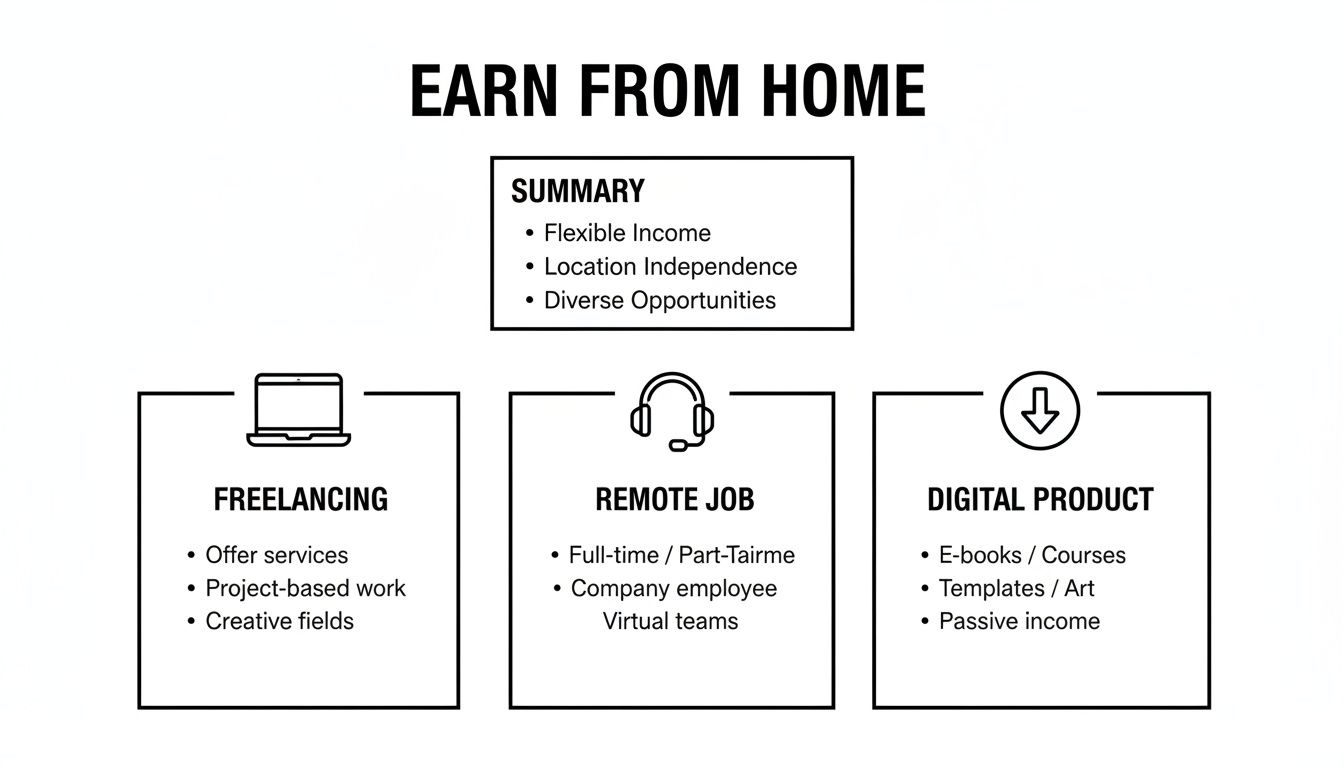
This highlights the key trade-offs between them. Each one strikes a different balance between startup cost and earning speed. They also have different long-term income potential. Your first step is choosing the one that best matches your personal goals.
Work-From-Home Income Streams at a Glance
Let’s compare some of the most popular work-from-home models side-by-side. This table will help you quickly see the differences in cost. It also shows earning speed and overall potential. This makes the choice even clearer.
| Income Stream | Startup Cost | Time to First $100 | Earning Potential (Monthly) |
|---|---|---|---|
| Freelancing | $0 – $200 | 1-4 Weeks | $500 – $10,000+ |
| Remote Job | $0 – $100 | 2-8 Weeks | $3,000 – $15,000+ |
| Digital Products | $100 – $1,000+ | 3-6+ Months | $100 – $20,000+ |
| Affiliate Marketing | $50 – $300 | 2-4 Months | $100 – $5,000+ |
| Virtual Assistant | $0 – $150 | 2-6 Weeks | $500 – $4,000+ |
As you can see, there's no single "best" path. Need money quickly with almost no upfront investment? Freelancing or a remote job are your strongest bets. Have time to build something for a bigger payoff? Creating digital products could be the perfect fit.
Building Your Freelance Business From Scratch
If you're looking for a way to earn money from home, freelancing is one of the most direct paths. It’s all about taking a skill you already have and turning it into a business. This isn't just theory. It's about monetizing your existing expertise. This includes skills like writing, graphic design, social media management, or bookkeeping.
Let's imagine a real-world scenario. Meet Alex, a marketing professional tired of the 9-to-5 grind. He’s great at his job, especially content writing. Instead of looking for another corporate role, he decides to offer his skills on a freelance basis. He's leveraging what he already knows. This means he can start immediately with zero startup costs.
Crafting a Winning Profile
Once you pinpoint your service, you need to show up where the clients are. Platforms like Upwork, Fiverr, and Freelancer.com are bustling marketplaces. They are perfect for getting started. Think of your profile on these sites as your digital storefront. It needs to be compelling.
A great profile does more than just list your skills. It clearly answers what you do and who you help. It also shows the results you deliver. Instead of "I am a writer," Alex’s profile headline reads differently. It says: "Content Writer for SaaS & Tech | Turning Complex Topics into Clear, Engaging Blog Posts." See the difference? It's specific. It instantly tells his ideal client he's the right person for the job.
To build a profile that attracts clients, make sure you:
- Use a professional headshot. A clear, friendly photo builds trust right off the bat.
- Write a benefit-driven overview. Don't just list your credentials. Focus on how you solve your client's biggest problems.
- Showcase your best work. No paid clients yet? No problem. Create a few high-quality samples to build your portfolio. Alex wrote three killer blog posts on tech topics to prove he had the chops.
Setting Your Rates and Landing First Clients
Figuring out what to charge can feel paralyzing for new freelancers. The most common rookie mistake is pricing yourself way too low. This devalues your work and attracts difficult clients. It often backfires.
A better approach is to do a little market research. See what other freelancers with your experience level are charging. A solid starting point is between $25 to $50 per hour for many skills. As you rack up experience, you can confidently start bumping up those numbers.
Securing your first client is a numbers game, but quality trumps quantity. It’s better to send five personalized proposals than 50 generic ones.
When Alex started bidding for jobs, he made each proposal count. He referenced a specific detail from the client’s post. He then explained how his skills were the perfect solution. That tailored approach showed he was genuinely interested. It made him stand out. You can find more strategies in our guide on how to start freelancing.
Common Pitfalls and How to Avoid Them
Making the leap to freelance work has its own challenges. Knowing the common tripwires ahead of time can save you a world of frustration.
| Common Mistake | How to Avoid It |
|---|---|
| Taking on Any and Every Project | Define your ideal client and project from day one. Get comfortable politely declining work that's a poor fit. |
| Not Having a Contract | Always use a simple contract or written agreement, even for small jobs. It should outline scope, deadlines, and payment terms. |
| Neglecting to Market Yourself | Don't just wait for work to come to you. Put up a simple website or maintain a professional social media presence. |
Early on, Alex accepted a low-paying project outside his tech niche. The work was a slog, and the client was demanding. It was a tough lesson. It taught him the value of sticking to his specialty. That focus helped him build a stronger reputation. It attracted the high-paying clients he wanted. Sidestepping these mistakes helps you build a sustainable freelance business.
Finding and Securing a Legitimate Remote Job
If the feast-or-famine cycle of freelancing isn’t for you, landing a remote job offers a fantastic alternative. You get the stability of a steady paycheck and benefits. You can do it all while working from your own space. The demand for remote workers is still incredibly strong. Companies of all sizes are hiring for full-time and part-time roles. It’s the best of both worlds. You get the freedom of remote life with the security of a traditional job.
To make the switch, you need to prove you have the right stuff for remote work. Employers look for people who are naturally self-disciplined. They want clear online communicators. They need workers comfortable with digital tools. These tools include Slack, Asana, or Microsoft Teams. These skills show a manager you can be trusted to perform well.

Give Your Resume a Remote-Ready Makeover
Your standard resume won’t cut it. You need to reframe your experience to highlight your remote work capabilities. Instead of just listing what you did, you have to show how you did it. You must prove you can work independently and effectively. This is your chance to show you have the mindset of a remote employee.
Think about accomplishments that scream self-motivation. Did you coordinate a project with a scattered team? That’s gold. Did you teach yourself new software to make things run smoother? Absolutely put that in your skills section.
- Highlight Remote-Friendly Skills: Explicitly list terms like “Time Management,” “Digital Communication,” and “Self-Discipline.”
- Showcase Your Tech Stack: Mention the specific collaboration tools you know. This could be Trello, Zoom, or Google Workspace.
- Use Action-Oriented Language: Frame your experience with strong verbs. Words like “Coordinated,” “Managed,” and “Implemented” are great. They paint a picture of a proactive, results-driven worker.
Where to Find Genuine Remote Job Openings
The internet is a minefield of job listings. Knowing where to look can save you from endless scrolling. Niche job boards that focus on remote work are your best bet. They tend to vet the companies posting on their site.
Of course, big players like LinkedIn and Indeed are still worth your time. Just make sure to lean heavily on their search filters. Using keywords like “remote” or “work from home” is essential. A mix of niche and broad platforms will give you the widest net.
The secret to a successful remote job search isn’t volume. It’s precision. A few customized applications sent to perfect-match roles will always beat hundreds of generic resumes.
Some of the most trusted platforms for finding remote work are:
- FlexJobs: This subscription service is known for high-quality, legitimate remote jobs. It’s worth the investment.
- We Work Remotely: One of the biggest remote work communities, featuring jobs from top-tier companies.
- Remote.co: A well-curated job board that focuses on quality over quantity, with excellent opportunities.
Spotting Red Flags and Acing the Interview
Sadly, the popularity of remote work has attracted scammers. You have to do your homework on any interested company. A legitimate business will have a professional website and a LinkedIn profile. It will also have employee reviews on a site like Glassdoor.
Be wary of job offers that sound too good to be true. Also, be careful if they ask you to pay for training or equipment. Interviews conducted entirely over text chat are another red flag. If you’re new to the workforce, our guide on online jobs for beginners is a great place to find safe starting points.
When you land an interview, get ready for remote-specific questions. A classic one is, “How do you stay productive without a manager physically present?”
Here’s how you knock that out of the park: “I’m very structured. I rely on a system to keep myself on track. I use a digital to-do list to set my priorities each morning. I block off ‘deep work’ time on my calendar. I also send regular progress updates via Slack. This ensures I’m always aligned with team goals.”
An answer like that shows you already have a plan.
Creating and Selling Your Own Digital Products
If the idea of scalable income excites you, this is a powerful path. Learning to create and sell digital products is one of the best ways to work from home. You build an asset once and can sell it over and over. It’s a shift from trading your time for money. Instead, you invest your time upfront in something that can generate revenue 24/7.
This path is a natural fit for anyone with a specific skill. The demand is there. The global e-learning market is expected to rocket past $457 billion by 2026.
Finding a Niche That Actually Sells
The secret to a successful digital product is solving a real problem. You must target a very specific group of people. Forget trying to appeal to everyone. Your power lies in focusing on a niche where you can become the go-to person.
For instance, instead of a vague “fitness guide,” drill down. A “30-Day Postpartum Yoga Guide for New Moms” is much more compelling.
To unearth a profitable idea, ask yourself a few simple questions:
- What do people ask me for help with all the time? This is a huge clue pointing to your natural expertise.
- What problem did I solve for myself? Plenty of other people are stuck on the same thing. They would pay for your shortcut.
- Where do I hang out online? Dive into Reddit threads, Facebook groups, or forums. Pay attention to what people complain about. Their frustrations are your market research.
Your goal is to pinpoint a pain you can eliminate. When you can help someone achieve a clear transformation, they will pay. This is a foundational concept we cover in our guide on how to create and sell digital products.
Choosing the Right Product Format
Once you have an idea, you have to package it in the right way. The format you choose should match your audience’s preferences. It should also match your own strengths. Don’t jump into creating a massive online course. A simple checklist might solve the core problem faster.
Here are a few popular formats to get you started:
- Ebooks and Guides: Ideal for sharing in-depth knowledge on a focused topic.
- Templates and Worksheets: These offer instant value. Think budget spreadsheets or content calendars.
- Printables: This includes things like digital planners or wall art.
- Online Mini-Courses: A short series of lessons designed to achieve one specific result.
The key is to start small. Create one high-value, low-cost product first. This lets you test the waters and build an audience. It avoids pouring months of work into something that might not resonate.
The Best Tools for Getting Started
You don’t need a big budget to get this off the ground. Modern tools have made the whole process incredibly straightforward.
For creating the product, a tool like Canva is a game-changer. You can design beautiful ebooks, worksheets, and templates. This works even if you have zero design skills. If you’re making a mini-course, a simple screen recorder like Loom is often all you need.
The most important thing is creating a product that delivers a real result. A simple, well-designed PDF that solves a problem is very valuable.
When it’s time to sell, you have great, user-friendly options:
| Platform | Best For | Why It's Great |
|---|---|---|
| Gumroad | Individual creators & beginners | Insanely simple setup; handles payment and file delivery for you. |
| Etsy | Creative and design-focused products | Taps you into a massive, built-in marketplace of active buyers. |
| Teachable | Courses and coaching | A more robust platform designed for hosting video-based courses. |
| Tactic | What It Looked Like |
|---|---|
| Authenticity | She only featured items she had paid for and loved. |
| Problem-Solving | Her post solved a real problem for her readers: creating a functional workspace. |
| Natural Integration | Links were part of the story, not a sales pitch at the end. |
| Visual Proof | She used her own photos, showing the products in action in her own space. |
That one blog post generated over $150 in affiliate commissions in its first month. While not a fortune, it was proof that her honest strategy worked. It’s a perfect example of turning genuine recommendations into a steady income stream.
The Tools and Habits You Actually Need to Succeed From Home
Making real money from home is about more than just finding the right gig. It’s about building the right habits and systems to support your work. If you want a sustainable career, you have to treat it like one. That starts with creating an environment that encourages focus.
Without a solid structure, the lines between work and home life get messy. That’s a one-way ticket to burnout.
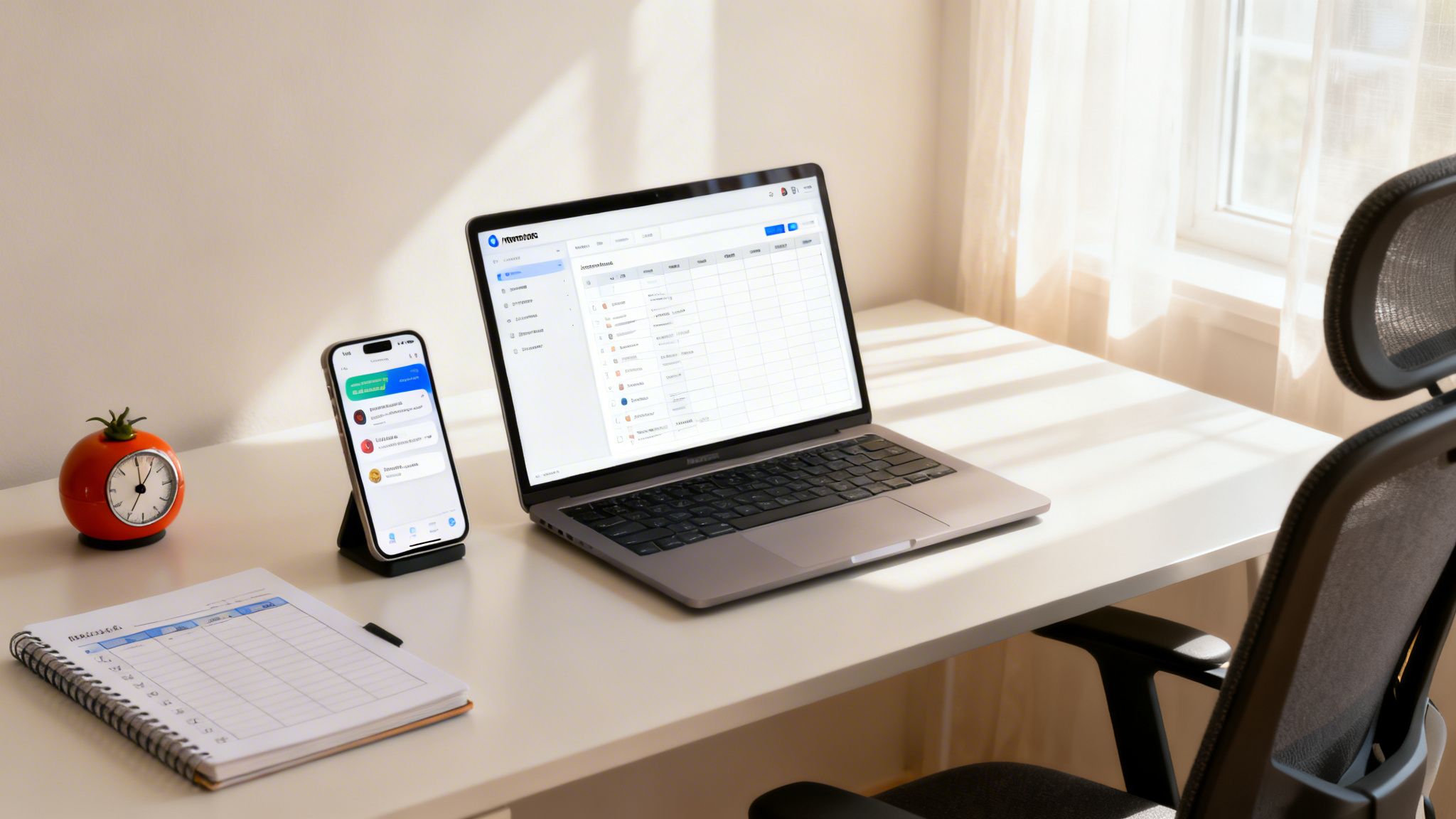
Your first move? Carve out a dedicated workspace. It doesn’t have to be a whole room. A corner of the living room works. It just needs to be your space for work. This physical boundary helps you mentally clock in and clock out. A consistent schedule is just as important. It’s your best defense against procrastination and working all night.
Your Starter Toolkit
You don’t need expensive software to get up and running. In fact, many of the best tools for managing your venture are free. They often have powerful free versions perfect for starting out.
- Project Management: I always recommend Trello to new freelancers. It uses a simple drag-and-drop card system. It gives you a clear visual of your entire workflow. You can easily track a project from pitch to payment.
- Communication: If you’re working with clients, get on Slack. It’s what the pros use. It keeps all your work chats in one place. More importantly, it keeps them out of your personal text messages.
- Finances: For sending invoices and tracking money, Wave is a lifesaver. It’s a free accounting tool that lets you create professional invoices. You can monitor your income from day one. No excuses for messy books.
If you want a deeper dive into software, you can learn about essential freelancer tools that boost efficiency.
How to Stay Focused and Avoid Burnout
The biggest challenge of working from home isn’t the work itself. It’s managing your own focus. This is where a simple technique can make a huge difference.
Try the Pomodoro Method: set a timer for 25 minutes. Work with zero distractions. When the timer goes off, take a five-minute break. After four of these “pomodoros,” take a longer break. It sounds almost too simple. But it trains your brain to focus intensely in short bursts.
Successful remote professionals are masters of setting boundaries. They turn off notifications. They have firm work hours, and they take real breaks. These aren’t just nice-to-haves. They are essential for staying productive and sane.
Ultimately, your success isn’t just about what you do, but how you do it. By pairing the right tools with solid habits, you build a professional foundation. This will support you for years.
Got Questions About Working From Home? Let’s Clear Things Up.
Jumping into the world of remote work always brings up a few big questions. Let’s tackle some of the most common ones I hear. This will help you move forward with a clear head. You can avoid the typical rookie mistakes.
The biggest unknown for most people? Money. It’s tough to know what to expect. Setting realistic goals is key to staying motivated.
How Much Can I Realistically Earn as a Beginner?
Honestly, it depends entirely on the path you take. If you’re diving into service-based freelance work like writing, aim for $15-$25 per hour. This is a solid, achievable starting point.
Working part-time, that could realistically bring in an extra $500-$1000 per month. Your income from gig platforms might start smaller. But as you rack up positive reviews, your earning potential grows. It’s all about building that initial momentum.
What Are the Most Common Scams to Avoid?
This is a big one. The internet is full of opportunities, but also traps. The number one red flag is any “job” that asks you to pay for training. Legitimate companies don’t do that. Period.
Be extremely wary of vague, high-paying “data entry” jobs. They are often a front for scams. My rule of thumb? Never give out bank details without a signed contract. Make sure you’ve thoroughly researched the company.
Do I Need a Bunch of Special Skills to Start?
Not at all. Technical skills like coding will always fetch a higher price. But there are plenty of entry-level remote jobs out there.
Many roles hinge on soft skills you probably already have. This includes customer service and virtual assistance. These jobs value organization, clear communication, and time management. You can pick up specific software skills from free online tutorials. This adds more value to your services over time.
Back to How to Build Multiple Streams of Income
Are you looking for better ways and tools to build your monthly revenue and brand? Be sure to check out our other resources located here to speed up the process.
Nathan
Dr. Nathan Pennington, DBA, earned his Doctor of Business Administration degree from the University of Missouri-St. Louis and brings over 15 years of online entrepreneurial experience in helping people learn how to blog, earn income online and build passive income streams outside of what the school system teaches.


