
How Much Money You Really Need to Start Crypto Trading (Beginner Guide)
If I’m trying to turn crypto trading into a side hustle, the first question I have to answer is simple, how much cash should I put at risk without messing up my budget. The truth is, I don’t need thousands to begin, but I do need enough to trade sensibly after fees and normal price moves. The person behind this brand knows how powerful cryptocurrency investing can be. My focus now is to help you and others take some chances and reap the benefits.
So, how much money do you need to start crypto trading? For most beginners, a realistic starting range is about $100 to $500, with $200 to $300 often feeling like a practical middle ground. It’s enough to place small buys and sells, learn how orders work, and still have room to be wrong once or twice without panic-selling.
When I say “start,” I mean three things: opening an exchange account, making my first buy or sell, and surviving normal price swings without blowing up my plan. The amount I need depends on my goals (learning vs. earning), the coins I trade, my time frame, and the fees on my platform.
Crypto trading isn’t guaranteed income, and it can punish sloppy risk. In this post, I’ll break down a realistic starting amount, what it depends on, and how to avoid the most common money mistakes, including over-sizing trades and trying to “make it back” after a loss. If I also want to build crypto exposure through everyday spending, I can look at this Gemini Credit Card review as a separate, lower-pressure option.
Back to How an I Become an Entrepreneur
The short answer: a smart starting range for most beginners
When I ask myself how much money do you need to start crypto trading, I come back to one practical rule: the right amount is what I can afford to lose without messing up rent, groceries, or debt payments. That’s it. Everything else is just math and self-control.
For most beginners, I like a simple tiered range: $50 to $500 to learn, then $500 to $2,000 for more flexibility. Some exchanges let me start with tiny buys, which is helpful, but if I go too small, fees and normal price moves can eat up the account fast. The goal early on isn’t “getting rich”, it’s getting good.
What I can do with $50 to $200 (learning mode without big risk)
At $50 to $200, I treat my account like a driving lesson in an empty parking lot. I’m here to learn the controls: market vs. limit orders, what a stop-loss does, and how fast prices can move when I’m not watching.
My realistic goals in this tier look like this:
- Learn order types without panic clicking.
- Test one simple strategy (for example, buying after a pullback instead of chasing pumps).
- Build habits like journaling trades and setting risk limits before I enter.
The limits show up quickly. With a smaller balance, I get fewer quality “shots,” and fees take a bigger bite. That’s why I avoid overtrading. Ten tiny trades can cost more than one planned trade, especially if I’m bouncing in and out.
A simple position-size example: if I deposit $100, I might buy in $20 chunks. That gives me room to practice entries and exits without going all-in on one price. I also keep it focused, usually 1 to 2 coins at first (often BTC and ETH), because it’s easier to learn one or two charts than juggle five.
If my account is small, my edge has to be patience. Overtrading is the fastest way to donate money to fees.
More Recommended Cryptocurrency Articles
Bitcoin
Fold App Review | Why Invest in Bitcoin
How Much is 0.05 Bitcoin | How to Earn Satoshis
0.001 BTC | How to Earn It Passively
CT Pool | Earn Bitcoin from Your Laptop
NC Wallet | How to Earn Bitcoin from Your Laptop
0.00001 BTC to USD | Why Consider CryptoTab Browser
Cryptotab Cloud Booster Review | Earn More BTC Online
Best Free Bitcoin Mining Sites
How to Build a Bitcoin Mining Rig
Fold App Review | How to Earn Bitcoin Rewards
How to Get 2 Bitcoins
Is Obtaining 15 Bitcoins Possible Now?
What Will 25 Bitcoins Be Worth in 2030
10 Bitcoin Advantages To Not Pass Up
PTGC (The Grays Currency)
Benefits of PTGC Coin
PTGC Affiliate Program Benefits
Where to Buy PTGC Crypto
How to Stake PTGC: Step-by-Step Guide
Is PTGC a Good Investment?
How to Buy the Grays Currency (PTGC)
What is the Gray’s Currency
How to Buy PTGC (Pulsechain The Greys Currency)
What is the PTGC Stock Price
PTGC Pulsechain Price and How to Invest
PTGC Crypto Price Prediction
How to Buy the Grays Currency on Coinbase
PTGC Coin Benefits
PTGC Crypto Website Benefits for Investors
What is PTGC Crypto
The Grays Currency Review for Investors
The Grays Currency PTGC Price Prediction 2030
PTGC The Grays Currency Benefits for Investors
PTGC the Grays Currency Price Prediction
PTGC Coin News
What is the Price Prediction for PTGC Coin?
PulseChain / PulseX
10 Reasons to Invest in Pulsechain
Pulsex Price (8 Ways it Will Rise)
ProveX – Is this New Richard Heart Coin Worth It?
Crypto Wallets & Storage
Best DeFi Wallet for Crypto Investors
Ledger Nano S Plus Review | Why Store Crypto Offline
Exchanges & Platforms
Coinbase vs eToro Review
How to Make Money on Coinbase for Beginners
Gemini Promo Code – Get $50 in Crypto When Trading $100
Crypto Cards & Payments
8 Benefits of the Gemini Credit Card
Gemini Credit Card Review for 2026
Can You Buy Crypto with Visa Gift Card
Crypto Earning & Side Hustles
15 Crypto Side Hustles to Earn More
How to Make Money with Blockchain
Blockchain / Crypto Technology
Can PrivateProver Technology Disrupt the Banking Industry?
What changes at $200 to $1,000 (more room for risk control)
Once I’m in the $200 to $1,000 range, I can trade with more control because I’m not forced into “all-or-nothing” decisions. I can keep cash aside for a second entry, a stop-out, or a better setup tomorrow.
This is where sizing starts to feel sane. Instead of putting $180 into one trade because that’s all I have, I can do something like:
- Put $300 at the exchange
- Keep $150 in cash inside the account
- Use $50 to $100 per trade and risk only a small fraction each time
As a result, I can take fewer, higher-quality trades and skip mediocre setups. I still can lose money, of course, but I’m less likely to blow up from one bad entry.
When $1,000 to $5,000 makes sense (only after I prove consistency)
I only move into $1,000 to $5,000 after I earn it with behavior, not confidence. Scaling too early feels like putting a bigger engine in a car before I learn to brake.
Before I add more money, I want proof:
- A written plan (when I enter, when I exit, what invalidates the trade).
- Several weeks or months of following it, even when I’m bored or stressed.
- Stable results, meaning my losses stay controlled and my process stays consistent.
The biggest trap here is adding funds to chase losses. If I’m down and I “top up” to win it back, I’m not investing, I’m reacting. Larger size also raises stress, and stress makes me break rules, move stop-losses, and take revenge trades.
In other words, this tier is for when my process feels boring in a good way, because boredom usually means I’m finally trading on purpose.
The real costs nobody mentions: fees, spreads, taxes, and transfer charges
When I’m figuring out how much money do you need to start crypto trading, I don’t just think about my first deposit. I think about the “invisible leaks” that slowly drain a beginner account. Fees, spreads, taxes, and transfer charges rarely look scary on their own, but together they can turn a decent plan into a frustrating grind.
If my budget is small, these costs matter even more because I’m paying them with a bigger slice of my account each time.
Trading fees and spreads: why small accounts feel it first
Trading fees are the direct cost charged by the exchange every time I buy or sell. Even when the fee rate looks tiny, frequent trading makes it add up fast.
Here’s an easy example. Say I have $100 and I make 20 round-trip trades in a month (buy, then sell), using my full balance each time. If my total cost per round trip is 0.8% after fees, I’m paying about $0.80 per cycle. After 20 cycles, that’s about $16 gone, before I even count any losing trades. On a $100 account, that hurts. On a $1,000 account, it’s annoying but survivable.
Most exchanges price trading fees using maker vs. taker:
- Maker: I place a limit order that sits on the order book and “makes” liquidity. It often costs less.
- Taker: I use a market order (or a limit order that fills instantly) and “take” liquidity. It often costs more.
Spreads are the sneaky cousin of fees. The spread is the gap between the buy price (ask) and sell price (bid). Every time I enter a trade, I’m effectively starting a little behind.
Low-liquidity coins are where spreads bite hardest. A popular coin might have a tight spread, while a thinly traded token can have a wide spread that acts like an extra fee. In other words, I can “pay” just to get in and out, even if the exchange fee is low.
If my account feels like it’s shrinking from “nothing,” it’s usually fees plus spread plus too many trades.
Deposits and withdrawals: when “free” isn’t really free
Getting money onto an exchange and off an exchange also has costs, and they show up at the worst times (like when I’m eager to start or trying to cash out).
For fiat deposits, the two common options are:
- Bank transfer (ACH or wire): Usually cheaper, sometimes free, but it can take longer. Some platforms also place a hold before I can withdraw.
- Debit or credit card: Faster, but the convenience often comes with higher fees. Also, card purchases can have extra rules depending on the exchange and issuer.
On the way out, crypto withdrawals can cost more than people expect. Exchanges usually charge a withdrawal fee, and the blockchain network itself may also have a cost baked in. The same coin can have different fees depending on the network I choose. For example, sending a token on one chain might cost pennies, while another chain costs several dollars during busy periods.
My simple rule: I plan transfers in batches. Instead of withdrawing $20 five times, I’d rather withdraw $100 once, assuming my security plan and minimums allow it. Repeated withdrawals are like paying shipping on five separate boxes.
Taxes: how much cash I should set aside so I’m not shocked later
Taxes are the biggest “surprise bill” for new traders because they don’t feel like a cost while I’m clicking buttons. However, the IRS doesn’t care that I rolled profits into the next trade.
In plain terms, these actions can trigger taxes:
- Selling crypto for dollars (or any fiat).
- Swapping one coin for another, even if I never touch cash.
- Spending crypto in some cases, because it can count like disposing of an asset.
Holding time matters too. In general, short-term gains (positions held for a year or less) are taxed differently than long-term gains. That’s why rapid trading can create a bigger tax headache, even when my account isn’t huge.
To keep it simple, I treat taxes like a “shadow expense” on profits. When I have a good month, I immediately set aside a percentage of my profits in cash, so I’m not forced to sell coins later just to pay a bill. The exact percentage depends on my situation, but the habit is what saves me.
Finally, I track every trade from day one, even the tiny ones. Dates, amounts, fees, and transfers add up quickly. If I wait until tax season, the cleanup work costs more time than the trading ever made.
How to pick a starting budget that fits your life, not your emotions
When I’m deciding how much money do you need to start crypto trading, I don’t start with a number. I start with my real life, my bills, my cash flow, and how I react to stress. If I pick a budget based on hype or a lucky streak, I usually pay for it later.
I treat my starting budget like a weight at the gym. Too heavy and my form breaks. Too light and I don’t learn much. The right weight lets me practice clean reps, track progress, and add more only when I earn it.
Before I fund an account, I run a quick decision process:
- Emergency fund check: If I don’t have a basic buffer, trading money feels like rent money.
- High-interest debt check: If I’m paying 20% APR, trading is a distraction.
- Monthly cash flow check: If I’m tight each month, I’ll panic-sell the first dip.
- Risk tolerance check: If a 10% swing ruins my mood, my position size is too big.
Then I use a simple budget ladder: I start small, I review results, and I add money only if I follow my rules. That keeps me focused on long-term financial independence, not short-term adrenaline.
My “can I afford to lose this?” test in 3 steps
This test keeps me honest because it forces a yes or no decision. If I can’t pass all three steps, I reduce my deposit until I can. I’d rather feel slightly underfunded than trapped in a cycle of stress trades.
- Bills and essentials are covered. Rent or mortgage, food, utilities, insurance, minimum debt payments, and transportation are handled first. If I’m behind on essentials, crypto is not my next move.
- I’m not borrowing to trade. No credit cards, no personal loans, no “I’ll pay it back after I win.” Borrowed money turns normal volatility into pressure.
- A full loss wouldn’t change my lifestyle. If losing the entire trading balance means skipping a bill, dipping into rent, or delaying groceries, the budget is too large.
Here’s the checklist I keep in my notes app so I can copy it before every deposit:
- My essentials are paid for this month.
- I have cash set aside for the next 30 days of bills.
- I’m not using credit or a loan to fund trading.
- Losing 100% of this deposit won’t affect rent, food, or debt payments.
- I can leave this money alone for at least 30 days.
- I accept that my first goal is skill building, not income.
If I’m trying to “feel better” by depositing more, that’s my cue to deposit less.
Trading account size vs time commitment: why beginners overestimate both
When I feel impatient, I’m tempted to believe a bigger account will fix everything. It won’t. More money doesn’t create more time, and it definitely doesn’t create discipline. It only makes my mistakes more expensive.
A small account can teach me the skills that matter: planning entries, setting exits, using stops, managing fees, and reviewing results. The trick is to trade less and review more. I can place fewer trades, take cleaner setups, and spend the rest of my time journaling what happened and why.
If I’m busy with work and family, I keep my trading plan simple:
- I pick a time window I can actually honor (for example, 20 minutes in the morning).
- I limit myself to a small watchlist so I’m not chasing noise.
- I set alerts and use limit orders so I’m not glued to charts.
Staring at charts all day is a fast path to burnout. It also pushes me toward impulse trades because my brain wants “action.” If I catch myself watching every candle, I step back and remind myself that boredom is often a sign I’m doing it right.
If I’m in debt or have no emergency fund, what I do first
If I’m serious about freedom, my priorities have to be boring and practical. Trading can wait. Stress debt plus an empty savings account is a bad mix for decision-making.
My priority order looks like this:
- Essentials first: housing, food, utilities, insurance, minimum payments.
- Emergency buffer: I build a basic cash cushion so surprises don’t force me to sell at the worst time.
- High-interest debt: I attack credit cards and other high-APR balances because the “return” is guaranteed.
- Then trading: only after the first three are stable.
I still like a compromise option, because I want momentum without risking my foundation. When I’m rebuilding, I do one of two things:
- Paper trading to practice order types, entries, exits, and journaling with zero financial pressure.
- A very small “tuition” amount, money I can lose without stress, while I build savings and pay down debt.
That tuition idea is also how I follow my budget ladder. I start small, track whether I followed my rules for a few weeks, then add funds only if my behavior stays consistent. If I break rules, I don’t add money. I tighten the plan.
At the end of the day, my starting budget is a tool. When it fits my life, I trade calmer, learn faster, and stay on track toward financial independence.
A simple risk plan that tells me exactly how much to start with
When I’m trying to answer how much money do you need to start crypto trading, I don’t start by picking a coin. I start by picking a loss limit that I can live with. That’s the difference between “learning a skill” and “hoping.”
My simple plan is built on three pieces that work together: risk per trade, a stop-loss, and position size. Once those are set, my starting budget becomes clear, because I’m no longer guessing.
The one rule that protects beginners: risk a small percent per trade
Risk per trade is the amount I’m willing to lose if I’m wrong. Not the amount I invest, and not what I “hope” to lose. It’s the planned, pre-approved hit I take if price touches my stop-loss.
Most beginners do well with 1% risk per trade. It sounds boring, and that’s the point. Boring risk keeps me alive long enough to get good.
Here’s what 1% risk looks like with easy numbers:
| Account size | 1% risk per trade | 2% risk per trade (aggressive) |
|---|---|---|
| $200 | $2 | $4 |
| $500 | $5 | $10 |
| $1,000 | $10 | $20 |
The takeaway is simple: small risk keeps me in the game. If I risk $5 and take a few losses, I’m annoyed, but I’m still trading. If I risk $50 because I sized randomly, a normal bad streak can wipe out weeks of progress and my confidence.
I don’t need to avoid losses. I need to avoid “one loss that breaks me.”
Why stop losses and position size decide my minimum starting money
A stop-loss is the line in the sand that tells me, “My idea didn’t work.” In crypto, tight stops often get clipped because price moves in quick bursts. That doesn’t mean stops are bad. It means my stop has to be realistic for the coin and the timeframe.
Now the key point: my stop distance controls my position size.
I use this beginner-friendly formula:
- Position size = (Account risk in dollars) ÷ (Stop distance %)
So if I have a $500 account and I risk 1% ($5):
- With a 5% stop, my position size is
$5 ÷ 0.05 = $100 - With a 10% stop, my position size is
$5 ÷ 0.10 = $50
This is why my account balance matters. Crypto volatility often demands breathing room. If I try to trade with a 2% stop because I want a huge position, I might get stopped out by normal noise.
Here’s how it plays out at common beginner balances, using a 5% stop:
- $200 account, 1% risk = $2, position =
$2 ÷ 0.05 = $40 - $500 account, 1% risk = $5, position =
$5 ÷ 0.05 = $100 - $1,000 account, 1% risk = $10, position =
$10 ÷ 0.05 = $200
If my account is too small, I get trapped in a bad choice:
- I keep my stop realistic, but my position becomes tiny, so fees matter more.
- Or I keep the position “meaningful,” but my risk becomes too big, so one trade can wreck me.
I also plan for slippage, because price can move fast. My stop might fill a bit worse than expected during a sudden drop, which means my real loss can be slightly bigger than the math. That’s another reason I like risking a small percent. I’m building a plan that survives messy real-world fills, not perfect textbook entries.
Diversification without overcomplicating it (and when it’s a bad idea)
Diversification doesn’t mean I buy 20 coins and hope one pops. For a beginner, that usually creates three problems: more fees, more confusion, and weaker decision-making.
My simple setup looks like this:
- 1 to 3 liquid assets that trade smoothly (high volume, tight spreads)
- Plus cash held back in the account
For example, I might focus on BTC and ETH, and maybe one other large, liquid coin if I have a strong reason. Then I keep a chunk in cash so I can handle volatility, re-enter at better prices, or just sit out.
This also helps with my risk plan. If I have a $500 account, I don’t want five tiny positions that I can’t manage. I’d rather take one clean setup with a clear stop and a position size that matches my 1% rule.
Diversification becomes a bad idea when:
- My positions get too small, so fees and spreads eat me alive.
- I can’t track my trades, so I start guessing instead of executing.
- Everything moves together anyway, which happens a lot in crypto when BTC sneezes and the market catches a cold.
In other words, my edge early on isn’t the perfect coin pick. It’s a repeatable risk process that keeps my losses small, my head clear, and my account intact long enough to learn.
Common beginner paths, and how much money each one usually needs
When I’m figuring out how much money do you need to start crypto trading, I like to start with the path, not the coin. Different styles put pressure on different parts of my budget: fees, time, and my ability to sit through normal drawdowns.
Here’s a quick way I think about the most common routes. The ranges below assume I’m trading spot (no margin), and I’m keeping position sizes small while I learn.
| Beginner path | Typical starting amount | Time required | Main risks |
|---|---|---|---|
| Buy and hold (with light rebalancing) | $50 to $300 | 10 to 30 minutes per week | Impatience, chasing hype, security mistakes |
| Swing trading | $300 to $1,500 | 20 to 60 minutes per day | Panic selling, poor stops, bigger drawdowns |
| Day trading | $2,000+ (often more) | 2+ hours per day | Fee drag, rapid losses, emotional trading |
| Bots and copy trading | $100 to $500 to test | 30 to 60 minutes per week | Blind trust, strategy failure, hidden fees |
The big takeaway: the “best” route is the one I can follow without breaking rules. A smaller budget can still work, but only if the style fits my schedule and temperament.
Buying and holding: the lowest-stress way to start small
Buying and holding works with smaller amounts because I’m not paying for constant action. If I make fewer transactions, I take fewer hits from fees and spreads, and I don’t need to be “right” today. Time becomes my advantage.
For most beginners, I see this path starting around $50 to $300, especially if I use dollar-cost averaging (DCA). DCA is just buying a fixed amount on a schedule (like $25 every Friday), so I don’t bet everything on one entry price. It’s like taking the stairs instead of trying to jump to the top floor.
I also keep it simple by rebalancing occasionally, not daily. For example, if my BTC or ETH grows too large versus cash, I trim a little and reset.
Security still matters, even for buy-and-hold. I stick to basics:
- Turn on 2FA right away.
- Use a unique password and don’t share codes.
- Ignore DMs, “support” messages, and giveaway links (scams love beginners).
Swing trading: fewer trades, but I still need a plan and patience
Swing trading means I hold positions for days or weeks, aiming to catch a larger move without watching every candle. That’s why it can fit side hustlers. I can check charts before work, set alerts, and manage orders with less screen time.
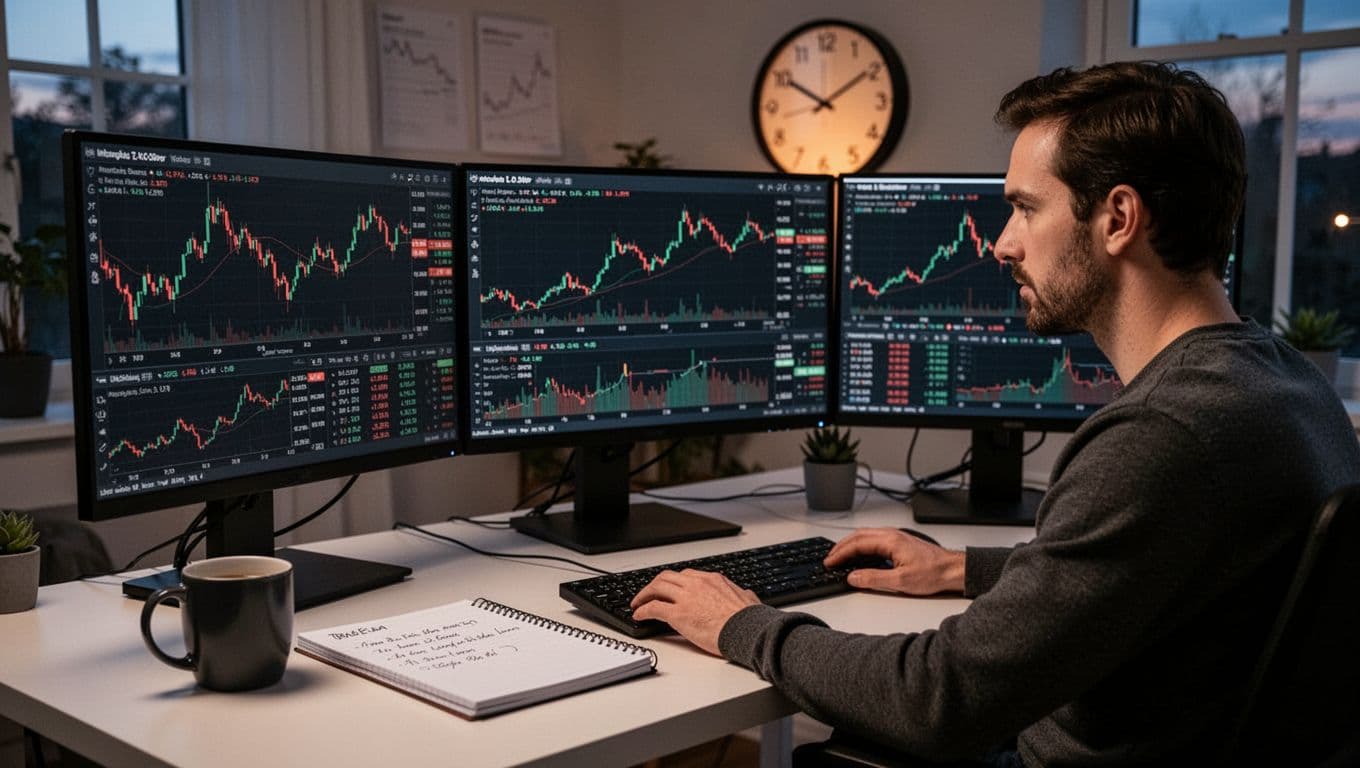
Budget-wise, I like $300 to $1,500 for this route. Could I do it with less? Sure, but small accounts get pushed around by normal drawdowns. A 10% dip feels very different on a $150 account when I’ve tied up most of the balance.
Swing trading also forces me to respect the “waiting game.” I need a plan for:
- Where I enter (not “somewhere around here”).
- Where I exit if I’m wrong.
- How I’ll respond if price chops sideways for a week.
If I can’t handle being down for a few days without touching the trade, swing trading will teach me that lesson the hard way.
Day trading: why it often needs more money than people think
Day trading sounds exciting, but it’s usually the most expensive classroom. The faster I trade, the more fees I pay. On top of that, beginners make more mistakes early, and day trading makes those mistakes happen at speed.
I usually don’t like day trading under $2,000, and many people still struggle at that level. That number isn’t a shortcut to profits. It’s just enough to:
- Take small, rule-based trades,
- Absorb a few early losses,
- Avoid going “all-in” to make a move worth it.
Underfunding makes it worse because I’m tempted to oversize trades to “feel” the win. That breaks risk limits and speeds up blowups. If I’m curious, I start by learning the basics from a guide like Crypto.com’s day trading overview, then I practice with tiny size until my process is steady.
Most beginners should avoid day trading until they can follow rules calmly for months.
Bots and copy trading: what I check before I put real money in
Bots and copy trading feel hands-off, but they can fail like any other strategy. Markets change, settings get misused, and fees can stack up quietly. The biggest danger is blind trust, because I stop thinking while my money keeps moving.
I test with the smallest amount possible, often $100 to $500, and I treat it like a trial, not a retirement plan. Before I fund anything, I run a quick checklist:
- Transparency: Can I see the strategy logic (at least in plain terms), or is it a black box?
- Track record realism: Are returns consistent with normal market behavior, or do they look too perfect?
- Max drawdown: How bad did it get during ugly periods, and how long did it take to recover?
- Stop control: Can I pause, close positions, and withdraw quickly, without hoops?
I also read cautionary notes from sources that don’t sugarcoat it, like Coin Bureau’s copy trading mistake guide. If I can’t explain how the strategy loses money, I’m not ready to fund it.
Conclusion
The honest answer to how much money do you need to start crypto trading is less about a magic number and more about a plan I can follow. For most beginners, I still like $100 to $500 (with $200 to $300 as a comfortable middle) because it lets me trade small, survive normal swings, and not get crushed by fees and spreads.
Still, the range changes fast based on four things: fees (too many small trades get expensive), taxes (every sell or swap can create a bill later), time (day trading usually costs more because it demands more trades), and risk rules (position size and stop-loss space decide what “small” really means). If I’m not tracking trades and setting money aside for taxes, I’m building a problem for future me.
My action plan is simple. First, I pick a path (hold, swing, or day trade). Next, I set a budget I can lose without stress. Then I write three rules: risk per trade (1% is fine), max trades per week, and when to stop (daily loss limit or rule-breaking). Finally, I start with a small amount for 30 days, journal every trade, and only add funds after I follow my rules. Thanks for reading, the goal is survival first, profits later.
Back to How Can I Become an Entrepreneur