
How to Start Affiliate Marketing: A Practical Guide for Beginners

Disclosure: This post may contain affiliate links, meaning if you decide to make a purchase through my links I may earn a commission at no additional cost to you. See my disclosure for more info.
Build A Smarter Online Business
Want to turn your content into traffic, income, and long-term freedom? Start with the guides built to help you grow smarter.
Explore Online Business Guides →Learning how to start affiliate marketing is a journey that comes down to four core things. You must pick a niche you are genuinely interested in. Then, build a platform where you can connect with people. Find solid affiliate programs to join. Finally, create content that actually helps your audience solve a problem.
At the end of the day, you’re becoming a trusted guide. Your job is to connect people with products that will make a real difference for them. You earn a commission for making that connection. It is this simple, low-risk approach that has made it a go-to for building an online income.
Back to How to Build Multiple Streams of Income
What Is Affiliate Marketing and Why Does It Work?

Think of affiliate marketing as a performance-based partnership. You, the affiliate, promote a company’s products. When someone in your audience clicks your unique referral link and makes a purchase, the company pays you. It’s a true win-win-win. The customer discovers a solution. The company gains a new sale. And you earn money for your valuable recommendation.
This model is a fantastic starting point for newcomers. You get to skip the hard parts of traditional business. You do not have to worry about creating a product or holding inventory. You also do not have to deal with customer support calls.
Your one and only job is to build an audience that trusts you. The initial investment is often little more than a domain name and some basic web hosting. This makes it incredibly accessible.
The Key Players in the Affiliate Ecosystem
To really get a feel for how the pieces fit together, you need to know who’s involved.
- The Affiliate (You): The content creator promoting the product. This could be anyone from a blogger or YouTuber to a social media influencer.
- The Merchant (The Brand): The company selling the product. They are the ones who give you a unique link to track your referrals.
- The Customer: The person who clicks your link and buys the product. Their purchase is what triggers your commission.
- The Affiliate Network (Optional): These are the middlemen. They are like ShareASale or CJ Affiliate. They connect you with thousands of brands, handle payments, and provide tracking tools.
This setup frees you to focus on what you’re good at—creating killer content. You can recommend products from a whole range of companies. This gives you the flexibility to build a business around topics you genuinely love.
The affiliate marketing world is booming. Spending in the U.S. alone shot up by 49.8%. It climbed from $9.1 billion in 2021 to an estimated $13.62 billion in 2024. That’s growing twice as fast as the rest of the e-commerce market. You can dive deeper into these numbers in this full performance marketing report.
Ready To Build More Traffic And Income?
Use Internet of Business to learn blogging, SEO, affiliate marketing, passive income, and digital business systems that compound over time.
Start Building Your Digital Income →
This guide is your roadmap. We are going to walk through everything. We will cover finding a profitable niche to creating content that pulls in visitors. By the end, you will have a clear framework to get your own affiliate business off the ground.
Finding Your Niche and Owning It
Let’s get one thing straight. Picking your niche is the single most important decision you will make. This is not just about grabbing a popular topic. It is not about chasing the highest commissions. It is about finding that sweet spot where your genuine passion, knowledge, and an eager audience all collide.
Think of it as your corner of the internet. A broad topic like “fitness” is a crowded stadium. But a focused niche like “at-home CrossFit for dads over 40” is a VIP lounge. There you can become the go-to expert. Your niche is the foundation of your entire business. Get it wrong, and everything else you build will be shaky.
Where to Look for Niche Ideas
The best place to start is right in your own backyard. What subjects do you find yourself geeking out about on a Saturday afternoon? Your authentic interest is your secret weapon. It is what will keep you going when you have to write that tenth blog post. It shines through in your content, building trust with your audience.
Next, layer on your expertise. What have you mastered? Maybe you are the person everyone asks for advice on building a gaming PC. Or maybe you figured out the perfect system for managing your freelance finances. These real-world skills are pure gold.
Here are a few places to look for ideas:
- Hobbies and Passions: Are you into drone photography, homebrewing, or sustainable gardening? Perfect.
- Professional Know-How: Turn your career skills into a niche. Think project management software, personal finance tools, or public speaking courses.
- Problems You’ve Solved: Did you successfully sleep-train a baby? Or plan an epic road trip on a shoestring budget? Those solutions are valuable content.
Is Your Niche Actually a Good Idea?
Passion is essential, but it does not pay the bills. You have to make sure there are actually people looking for what you are offering. A deep love for collecting vintage milk caps is great. But the audience might be a little small.
A quick trip to Google Trends is a great first step. Is interest in your topic growing, or is it a dying fad? You can compare a few ideas, like “keto diet” versus “vegan diet”. This shows you the search volume over the last few years. This simple check can save you from betting on a losing horse.
Your goal is to find a niche with a profitable audience. But not so massive that you compete with giants from day one. It is about becoming a big fish in a small, well-stocked pond.
Once you have a shortlist, it is time to check for profitability. You can get a great overview of what is working right now. Check out guides on the 10 best niches for affiliate marketing. For a deeper dive, our own guide to the best niches for affiliate marketing can give you more inspiration.
Get to Know Your Ideal Reader
Before you write a single word, you need to know who you’re writing for. This is where creating an audience persona comes in. This is not just a silly marketing exercise; it is a game-changer.
Give your ideal reader a name, an age, and a job. Most importantly, list their biggest headaches and goals. For a niche like “ergonomic home office setups,” your persona might be “Remote Work Ryan.” He is a 32-year-old software developer struggling with back pain. He wants a comfortable workspace but does not know where to start.
When you know Ryan’s pain points, you can create content that speaks directly to him. You will understand his Google searches and his hesitations. You will know what will finally convince him to click “buy.” This deep connection turns casual visitors into loyal followers and customers.
Choosing Your Platform and Affiliate Partners
Alright, you’ve zeroed in on your niche. Now comes the fun part: deciding where you are going to build your brand. This is not just a small choice. It is the foundation of your entire affiliate business. The platform you pick dictates how you’ll create content. You want to choose one that plays to your strengths. More importantly, choose one where your target audience hangs out.
Every platform has its own vibe and set of rules. Your job is to figure out which one feels the most natural for you. It also needs to be the best fit for the people you want to reach.
Select Your Content Platform
For those of us who love to write, a blog is a no-brainer. It is your own corner of the internet. You can dive deep into product reviews and create detailed how-to guides. You can also compare different options for your readers. The real magic of a blog is SEO. A single great article can pull in organic traffic from Google for years. It’s a true long-term asset.
If you are more of a talker than a typer, YouTube is your stage. Video is incredibly powerful for showing, not just telling. You can unbox products, film tutorials, and build a genuine connection with viewers. This is especially effective in hands-on niches like tech, beauty, or home improvement.
Then there’s the email newsletter. This is your direct line to your most loyal followers. It is often paired with a blog or YouTube channel. But it is a powerhouse on its own. It lets you nurture relationships and present offers in a more personal, conversational way.
This decision tree gives you a great visual for how to match your interests to a viable niche. This is exactly what you need to figure out before you commit to a platform.
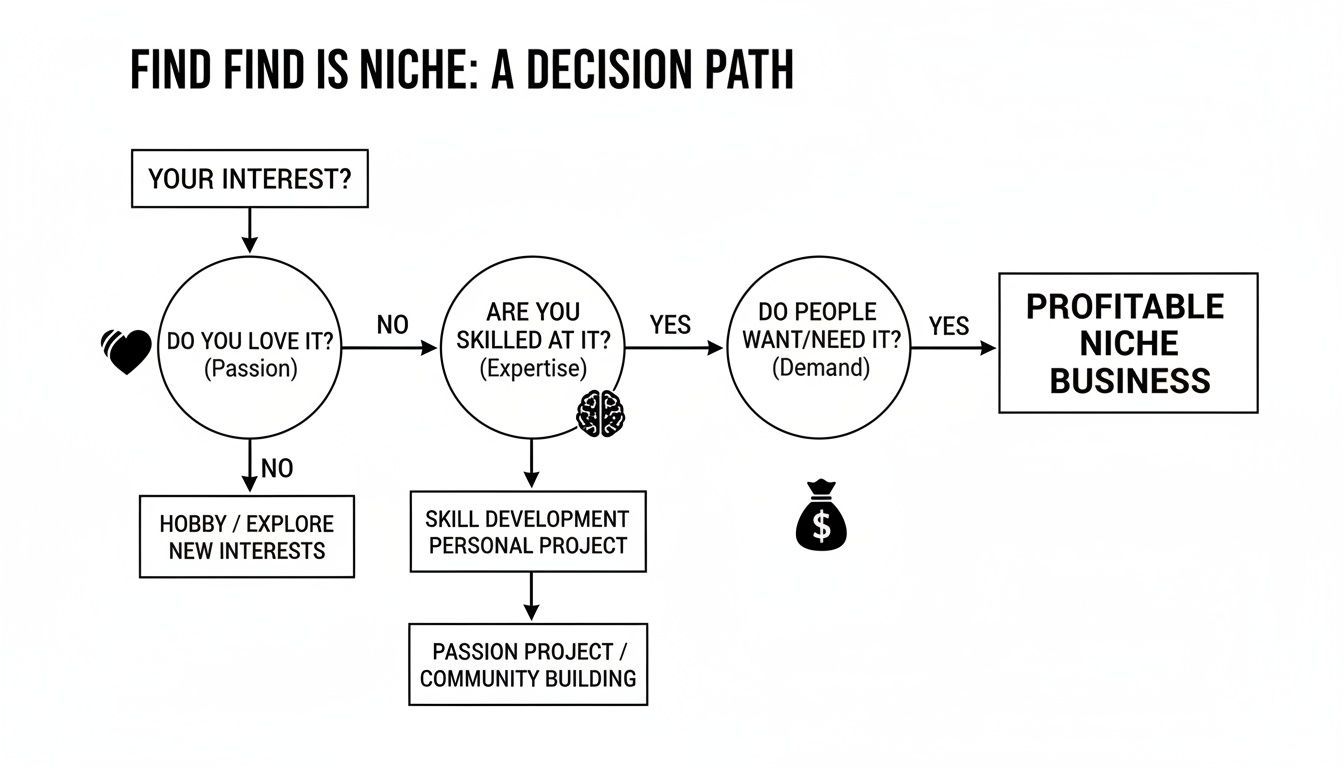
As you can see, the sweet spot is where your passion, expertise, and what people will pay for all overlap. That’s the solid ground you want to build your business on.
Find and Evaluate Affiliate Programs
With your platform locked in, it is time to find companies to partner with. A lot of beginners gravitate straight to Amazon Associates. While it is a solid starting point, do not stop there. Thousands of incredible programs are waiting for you on affiliate networks. Think of these networks as massive marketplaces. They connect you with countless brands all under one roof.
Some of the biggest players you should check out are:
- ShareASale: A fantastic network with a huge variety of merchants. It is great for finding unique products from small and medium-sized businesses.
- CJ Affiliate: This is where many of the big, household-name brands live. It’s a robust platform that’s perfect once you have some traffic coming in.
- Impact: A more modern platform. It is home to a lot of tech companies, SaaS products, and cool direct-to-consumer brands.
Getting on these networks is a smart play. Over 81% of advertisers and 84% of publishers are using affiliate marketing. This tells you everything you need to know. This is a core part of modern business, and there are tons of opportunities.
What to Look for in a Partner
Here’s a hard truth: not all affiliate programs are worth your time. To protect your reputation and actually make money, you must be selective. The right programs will feel like a natural extension of your brand. The wrong ones will just feel sleazy.
Your credibility is your most valuable asset. Only promote products from companies that you genuinely believe in. They must provide real value. A short-term commission is never worth losing your audience’s trust.
Before you think about signing up, do some digging. Get clear on these key details:
- Commission Rate: This is what you get paid. It can be a percentage or a flat fee. Rates are all over the map—from 1% to over 50%. See what’s standard in your niche.
- Cookie Duration: This is how long you have to get credit for a sale. A 30, 60, or 90-day window is always better than a short 24-hour one.
- Merchant Credibility: Look up the company. Are customer reviews positive? Is their product good? Promoting junk will tarnish your name fast.
- Payout Terms: Know the rules. Is there a minimum amount you have to earn before they pay you (e.g., $50)? How often do they pay out?
The Amazon Associates program is popular for a reason—the product selection is massive. But its short cookie duration and changing commission structure can be a real headache. To get the full picture, check out our in-depth guide on the Amazon affiliate program.
Ultimately, building a resilient affiliate business means diversifying your partners. Do not put all your eggs in one basket.
4. Create Content That Actually Converts

You’ve picked your niche, found your audience, and lined up your affiliate programs. Now comes the fun part—creating the content that will drive your business. This is where the magic happens. This is where you build trust and turn readers into buyers.
The trick is to create genuinely helpful content. Your affiliate link should feel like the next logical step, not a hard sell. Your primary job is to solve a problem or answer a question. Do that well, and the commissions will follow.
The Anatomy of High-Converting Content
Not all content is created equal. You can stick an affiliate link in just about anything. But some formats are simply built to convert. These pieces meet people exactly where they are in their buying journey.
To get the best results, focus your energy on these tried-and-true formats:
- In-Depth Product Reviews: Go way beyond the spec sheet. Share your real experience. Talk about what you loved and what you did not. Show the product in action if you can.
- Comparison Posts: This is a goldmine. Pit two or three popular products against each other. Your audience is already looking to buy. They just need help making that final decision.
- “How-To” Guides and Tutorials: Walk someone through solving a problem, step by step. You can naturally recommend the tools or products that make the process easier.
These formats are powerful because they target readers with high commercial intent. They are actively looking for solutions. They are often ready to make a purchase. For a deeper dive, this modern content marketing strategy guide offers excellent frameworks for these articles.
Understanding which content formats deliver the best results is key. Some are designed for deep engagement. Others are built for quick decisions.
High-Converting Content Types
| Content Type | Best For | Conversion Potential |
|---|---|---|
| Product Reviews | Building authority and trust with detailed analysis | High |
| Comparison Posts | Targeting buyers who are at the final decision stage | Very High |
| “Best Of” Listicles | Catching searchers looking for top recommendations | High |
| How-To Guides | Solving a specific problem and recommending a product as part of the solution | Medium-High |
| Case Studies | Showing real-world results using a specific product or service | Medium |
Ultimately, a good content strategy uses a mix of these formats. Start with the ones that align best with your niche. Focus on your audience’s most pressing questions.
Writing Copy That People Trust
Your writing style matters just as much as your content format. Forget corporate jargon and pushy sales talk. To get people to click your links, you need to sound like a real person. You must offer genuine advice.
Write like you’re talking to a friend. Be conversational. Share personal stories about your experience with a product. And most importantly, be honest. If a product is perfect for beginners but not for pros, say so. That kind of transparency builds massive credibility.
The most successful affiliates are educators, not salespeople. Your audience is not looking for a brochure. They are looking for an expert opinion they can trust. When you provide that, the conversions will follow.
When you add your affiliate links, make them feel natural. Instead of a big, loud “CLICK HERE!” button, link the product name. Do it when you first mention it or when you are explaining a key feature. Your call-to-action should feel like a helpful suggestion, not a demand.
Don’t Forget Your Disclosures
Being transparent about your affiliate links is not just good ethics. It is a legal requirement. The Federal Trade Commission (FTC) requires you to clearly disclose that you might earn a commission.
Do not bury this in your website’s footer. Place it right at the top of your post. It should be before any affiliate links appear. A simple statement is all you need.
Something like, “Just a heads-up: This post contains affiliate links. If you make a purchase, I may earn a small commission at no extra cost to you.”
Far from hurting your conversions, this honesty actually helps. It shows your audience you have nothing to hide. This only strengthens the trust you are working so hard to build. Of course, great content needs to be seen. Make sure you understand how to write SEO-friendly blog posts.
The effort you put in now pays dividends later. Affiliates with three to five years of experience earn an average of $10,789 per month. Affiliate marketing spend in the U.S. is projected to hit over $13 billion by 2026. There’s plenty of room for new creators committed to providing real value.
Getting Your First Visitors and Building Momentum

Creating fantastic content is only half the job. The other, harder half is getting people to actually see it. When you are new, it is easy to feel like you need to be everywhere at once. That is a recipe for burnout.
Instead, let’s simplify. Pick just one or two channels and get really good at them. Your mission is to build a reliable stream of visitors. They should be genuinely interested in your niche. For most new affiliates, the most potent combo is Search Engine Optimization (SEO). Pair it with one solid social platform. This one-two punch gives you long-term stability and a way to connect with people right now.
Mastering the Basics of SEO
Think of Search Engine Optimization as making your content irresistible to Google. The field of SEO is massive. But the fundamentals are surprisingly simple. At its heart, your job is to create content that answers a specific question. It must be better than anyone else on the internet.
It all starts with keyword research. You need to get inside your audience’s head. Figure out the exact phrases they are typing into Google. More importantly, you are looking for keywords with commercial intent. These phrases signal someone is ready to pull out their wallet.
Just look at the difference between these two searches:
- “what is a drone” (This person is just learning.)
- “best drone for travel photography” (This person is looking to buy.)
That second searcher is your ideal visitor. By targeting these kinds of keywords, you attract an audience that is already in a buying mood. This is exactly what you want as an affiliate.
Simple On-Page SEO for Beginners
Once you have your keyword, you need to optimize your content around it. “On-page SEO” just means tweaking things directly on your web page. This helps Google understand what it is about. Do not get lost in the weeds here. Just nail these few basics for every article you publish.
Here’s a quick checklist to get you started:
- Title Tag: Your main headline. Make sure it includes your primary keyword and is catchy enough to earn a click.
- Meta Description: This is the little blurb under your title in search results. Write a quick, persuasive summary that also includes your keyword.
- URL Structure: Keep your URLs clean. For example,
yourwebsite.com/best-travel-dronesis better thanyourwebsite.com/p=123. - Introduction: Weave your main keyword into the first paragraph. This tells both readers and search engines what your article is about.
SEO is a marathon, not a sprint. You won’t see results overnight. But the content you optimize today can bring you free, passive traffic for years. This is how you build a real, sustainable affiliate business.
By applying these principles consistently, you’re laying a rock-solid foundation. It is all about patience and a methodical approach. Focus on one well-optimized piece of content at a time.
Choosing a Second Traffic Channel
While SEO quietly builds your long-term traffic engine, you need a spark now. That is where a second platform comes in. The trick is to pick one and go all-in. Do not try to juggle five different social networks.
The best platform for you comes down to your niche and audience.
- In a highly visual space like home decor, recipes, or fashion? Pinterest can be a goldmine. It functions more like a visual search engine. A single popular pin can send you traffic for months.
- Is your niche more business-focused, like software reviews? A platform like X (formerly Twitter) or a dedicated Facebook Group might be a better fit.
Your strategy is simple. Find where your people hang out online. Become a genuinely helpful voice in that community. Share insights from your blog, answer questions, and build real relationships. Provide value first, and the traffic will naturally follow. This focused approach makes learning how to start affiliate marketing feel less overwhelming.
Tracking Your Success and Scaling Your Income
Getting your content published is a huge step. But that is where the real work begins. To grow your income, you have to get comfortable with tracking and optimizing. Just hitting “publish” and hoping for the best is not a strategy—it is a gamble. Using data to make smart decisions is what separates a side hustle from a scalable business.
Success in this game boils down to understanding your numbers. You do not need to be a data wizard. But you do need to get familiar with a few key performance indicators (KPIs). Think of these metrics as the language of your affiliate business. They tell you exactly what is resonating with your audience and what is falling flat.
Key Metrics Every Affiliate Should Monitor
Your affiliate dashboard is a treasure trove of information. It is tempting to just look at the total earnings. But the real gold is hidden in the details.
Make it a habit to check these metrics regularly:
- Click-Through Rate (CTR): This is the percentage of people who see your affiliate link and click it. If your CTR is low, it could be a sign your links are buried. Or your call-to-action is not strong enough.
- Conversion Rate: This tells you what percentage of those clicks turn into a sale. A ton of clicks but few conversions is a red flag. It often means there is a mismatch between your content and the product’s sales page.
- Earnings Per Click (EPC): This is your average earnings for every click you send to a merchant. It is a fantastic way to quickly see which affiliate programs are making you the most money.
Tracking these numbers helps you move beyond pure guesswork. Data will show you which articles convert best. It shows which products your audience values. It also shows where you should be putting your time and energy.
Keeping a close eye on your performance lets you double down on what works. For instance, you might notice your comparison posts have a high EPC. If it is 3x higher than your product reviews, you know exactly what to write next. This data-first mindset is the core of creating sustainable affiliate marketing passive income.
Scaling Your Affiliate Business
Once you have a consistent flow of traffic and a solid grasp of what converts, it is time to scale. This is not just about doing more of the same. It is about strategically growing your business.
The first move is almost always diversification. Putting all your eggs in one basket is a huge risk. Relying on a single affiliate program or traffic source is dangerous. Commissions can get cut, and search engine algorithms can change overnight. This can wipe out your income in an instant.
Here are a few scaling strategies to consider:
- Join more affiliate programs in your niche. This spreads the risk and reduces your dependency on any single partner.
- Expand to a new traffic channel. If your blog is doing well, think about starting a YouTube channel or an email newsletter.
- Reinvest your profits into tools that give you your time back. Consider a premium SEO tool or a robust email marketing service.
Ultimately, scaling is about building a resilient business. It must weather the inevitable ups and downs. By tracking your success and intelligently reinvesting, you can build multiple income streams. You can turn your affiliate project into a truly profitable online asset.
Answering Your Top Questions
Getting started in affiliate marketing always brings up a few big questions. Let’s tackle them head-on. This way you can move forward with clarity and avoid common rookie mistakes.
So, How Much Can I Realistically Make?
This is the million-dollar question, isn’t it? The honest answer is that your income potential is all over the map. It depends on your niche, traffic quality, and your strategy.
Many affiliates build a respectable side hustle. They bring in a few hundred dollars a month. On the other end, super-affiliates clear six or even seven figures a year. A massive factor is picking affiliate programs that pay well. Aim for offers that pay over $100 per sale if it makes sense for your audience.
Just remember, this is not a get-rich-quick scheme. The real money comes from consistently creating helpful content. You must build an audience that trusts you. It takes time, but the potential for a solid passive income stream is very real.
Do I Absolutely Need a Website to Get Started?
A blog or a dedicated website is the classic, time-tested foundation. It is an asset you own and control. But is it the only way? Absolutely not. You can build a successful affiliate business on any platform where you can connect with an audience.
Think about these alternatives:
- YouTube: Video is king for product reviews, in-depth tutorials, and unboxing experiences.
- Email Newsletters: This is your direct line to your audience. It is an incredibly powerful way to build trust and share recommendations.
- Social Media: Do not underestimate platforms like Pinterest for visual products. Or use a niche Facebook Group for building a tight-knit community.
The specific platform does not matter as much as the principle behind it. You just need a place to share your affiliate links. You need people who are interested and engaged.
Key Takeaway: You do not need a massive following to start earning. Focus on building a small, engaged community that trusts your recommendations. Your income will grow from there.
Back to How to Build Multiple Streams of Income
Are you looking for better ways and tools to build your monthly revenue and brand? Be sure to check out our other resources located here to speed up the process.
Nathan
Dr. Nathan Pennington, DBA, earned his Doctor of Business Administration degree from the University of Missouri-St. Louis and brings over 15 years of online entrepreneurial experience in helping people learn how to blog, earn income online and build passive income streams outside of what the school system teaches.


