
How to Negotiate Freelance Rates Effectively

Disclosure: This post may contain affiliate links, meaning if you decide to make a purchase through my links I may earn a commission at no additional cost to you. See my disclosure for more info.
Build A Smarter Online Business
Want to turn your content into traffic, income, and long-term freedom? Start with the guides built to help you grow smarter.
Explore Online Business Guides →Knowing how to negotiate freelance rates isn’t something that starts on a client call. The real work begins much earlier. It is grounded in a solid understanding of your own numbers.
It also requires knowing your place in the market. When you can justify your pricing with hard data, you walk into every conversation with unshakable confidence.
Back to How to Make an Online Business
Building Your Foundation for a Confident Negotiation

Before you can name your price, you must know what your time is truly worth. That confidence you’re aiming for comes from clarity on your finances and market value. Without this prep work, you’re just guessing. That is a quick path to undervaluing your work. It also leads to taking projects that don’t pay the bills.
Part of this foundational work involves setting up your business correctly. For many freelancers, that means understanding the distinction between incorporation and sole proprietorship. This helps you get a better handle on finances and legal protections.
Calculate Your Minimum Acceptable Rate
Think of your Minimum Acceptable Rate (MAR) as your financial baseline. It’s the absolute lowest you can charge to keep your business running. This isn’t the rate you want to charge; it’s the rate you must charge. Knowing this number takes emotion out of the negotiation. It acts as a guardrail, preventing you from accepting unprofitable work.
To find your MAR, you need a complete picture of your costs:
- Business Expenses: Tally up everything from software subscriptions to new hardware.
- Tax Obligations: You have to be your own payroll department. Set aside 25-30% of your income for taxes.
- Personal Salary: This is what you need to cover your personal life. This includes rent, groceries, and utilities.
- Profit Margin: A healthy business needs to grow. Aim to add a 10-20% profit margin for savings and reinvestment.
This is a critical step for anyone aiming for long-term success. Knowing your numbers is simply non-negotiable.
A classic rookie mistake is basing a rate solely on personal living expenses. Forgetting to account for taxes and overhead is the fastest way to feel overworked. Your rate needs to support both you and your business.
Ready To Build More Traffic And Income?
Use Internet of Business to learn blogging, SEO, affiliate marketing, passive income, and digital business systems that compound over time.
Start Building Your Digital Income →
Research Your Specific Market Rates
Once you’ve defined your financial floor, look outward. See what the market is actually paying for your skills. You’ll find that freelance rates can be all over the map. For example, some reports cite a global average hourly rate of $101.50. That figure is heavily skewed and not very useful.
A closer look reveals that the US average is closer to $48 per hour. In Germany, it’s around $29.86. This is why broad, global averages are a terrible benchmark. Your research has to be laser-focused on your specific industry, niche, and location. Coming to the table with relevant data is more persuasive than quoting a global number.
Choose The Right Pricing Model
With your minimum rate calculated, the next step is deciding how you’ll charge. The structure you choose can impact everything from cash flow to client perception. Each model has its place. The best one often depends on the project’s scope.
Here’s a breakdown to help you decide which approach fits best.
Choosing Your Freelance Pricing Model
| Pricing Model | Best For | Pros | Cons |
|---|---|---|---|
| Hourly | Projects with unclear scope or ongoing tasks needing frequent feedback. | Simple to track. Ensures you’re paid for all time spent. Flexible for changing needs. | Can punish efficiency. Clients may micromanage hours. Creates an income ceiling. |
| Project-Based | Well-defined projects with clear deliverables and a predictable scope. | Focuses on value, not hours. Rewards efficiency. Predictable income. | Risk of scope creep without a tight contract. Requires accurate estimation. |
| Retainer | Long-term clients who need consistent, ongoing work each month. | Provides stable, predictable monthly income. Fosters a strong partnership. | Can lead to being “on-call.” The scope can expand if not clearly defined. |
Ultimately, you’re not locked into one model forever. Many successful freelancers use a hybrid approach. The key is to choose the model that aligns with the client’s needs while protecting your time.
Positioning Your Value to Command Higher Rates
Your ability to negotiate great rates comes down to one thing. You must explain your unique value well. It’s not about the hours you put in. It’s about the tangible results you create for your clients. Shift the conversation from cost to investment. Once you master that, you’ll start landing premium rates.
A big part of this is building a professional presence. Learning how to get clients on platforms like Fiverr and Upwork can be a solid first step. It puts you where potential clients are actively looking.
Specialize to Stand Out
Here’s a hard truth: generalists compete on price. Specialists compete on value. When you carve out a specific niche, you’re no longer just another freelancer. You become an expert with a very specific, in-demand skillset. That specialization immediately makes you stand out. It gives you the leverage to charge more.
Clients will happily pay a premium for someone who gets their industry. Calling yourself a “writer” is fine. Being a “B2B SaaS copywriter for the fintech space” makes you an invaluable asset. This focus makes your marketing easier. It also makes you the obvious choice for select clients.
Focus on Results, Not Hours
Stop selling your time. It’s a commodity. Instead, start selling outcomes and a clear return on investment (ROI). Clients don’t really care about your hours. They care about what you can achieve for them. Frame your services around the value you create. This could be boosting their sales or making their processes more efficient.
The data backs this up. General marketing services might pull in around €150 per hour. Specialized work like video production can command €200. The gap is even wider in tech. A junior software developer might make $20-$40/hr. A senior developer can earn $70-$160/hr.
When a client asks for your hourly rate, try to pivot the conversation. I often say something like, “To give you an accurate price, I’d first love to understand your goals.” Then I ask, “Can you tell me more about what success looks like for you?”
Build a Portfolio That Proves Your Worth
Your portfolio is your best salesperson. It’s the tangible proof that you can deliver on your promises. A powerful portfolio doesn’t just showcase your finished work. It tells a compelling story of success through detailed case studies.
For each project you feature, make sure you clearly lay out:
- The Client’s Problem: What specific challenge were they facing before they found you?
- Your Solution: What strategy did you develop? What services did you provide to execute it?
- The Tangible Results: This is where you bring in the numbers. Did you increase website traffic by 40%? Did you boost conversion rates by 15%?
This approach transforms your past projects into undeniable proof of your value. It’s an essential step for every freelancer. When you document your wins this way, you make it easy for new clients to see you as a strategic investment.
Mastering the Negotiation Conversation
Alright, you’ve done the homework. You know your numbers and you’re clear on your value. Now comes the part that makes most freelancers sweat: the actual negotiation. But this isn’t a confrontation; it’s a conversation. Your goal is to frame this as a partnership focused on results.
One powerful psychological tool is anchoring. It’s simple: you start the conversation with your ideal rate. This first number sets the high end of the scale. It creates a mental benchmark for the client. Any number below that anchor will feel like a reasonable compromise.
Presenting Your Rates with Confidence
How you say your price is just as important as the number itself. State your rate clearly and directly. Then, stop talking. The biggest mistake freelancers make is rushing to justify their pricing. This screams insecurity and invites haggling.
Your delivery should be firm, yet collaborative.
- On a call, you could say: “Based on the scope we’ve discussed, the project investment is $4,000.”
- In an email, try this: “Thanks for walking me through the project details. My rate to deliver the outcomes we talked about is $4,000.”
This approach immediately reframes the dynamic. You’re not just a hired gun. You’re a professional consultant guiding them toward an investment. This is a crucial skill, whether landing clients or learning how to make money on Upwork.
That silence after you state your price? It’s golden. Let them sit with it. Let them process the number. If you jump in with “but I can be flexible,” you’ve already lost ground.
Positioning your value doesn’t happen by accident. It’s a deliberate process of specializing and proving you can get results.
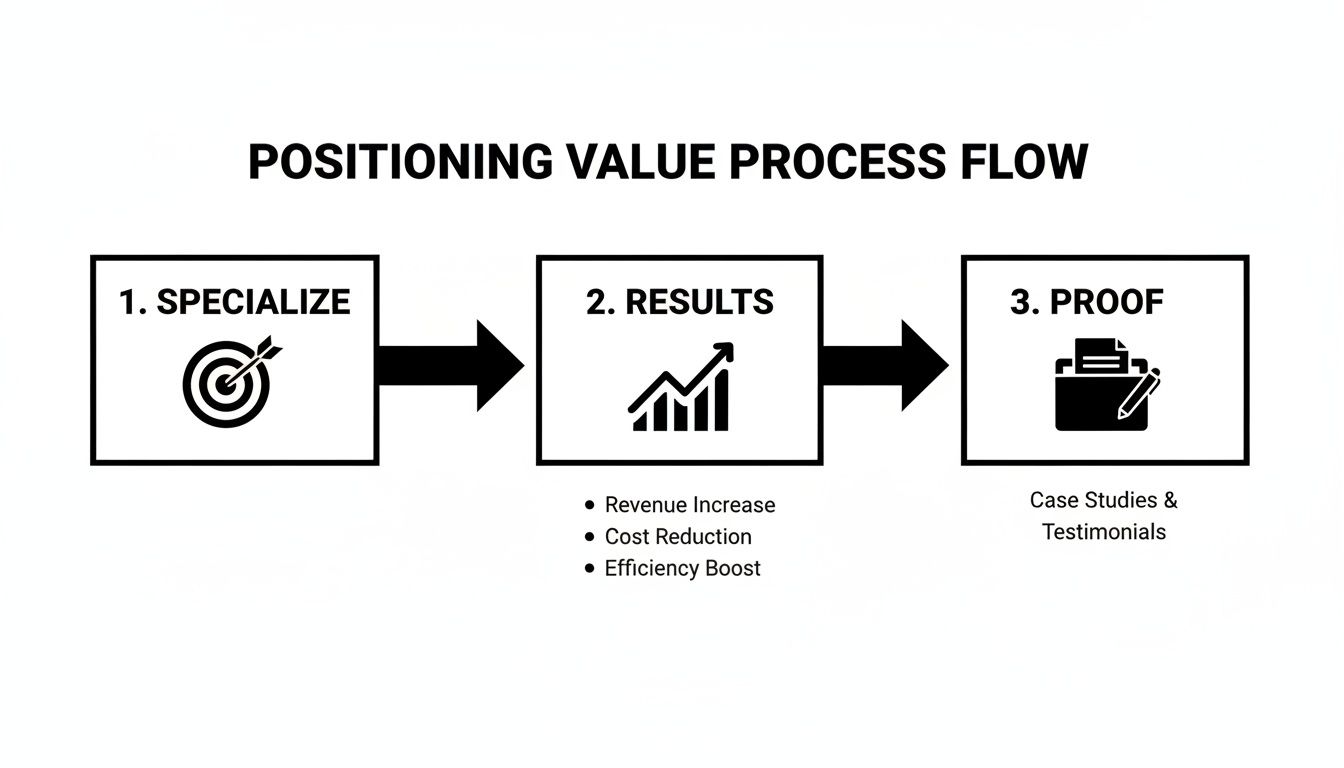
This visual just hammers home the point. A strong negotiation is built on a foundation of value. You establish this long before you ever talk about money.
Responding to Client Pushback
Inevitably, you’ll hear, “That’s a bit more than we were expecting.” Don’t panic. This isn’t a “no”—it’s an invitation to have a conversation. The key is to stay calm and professional. Shift the focus back to solving their problem.
Here are a few ways to keep the discussion productive:
- “I understand. Can you share what budget you had in mind?”
- “I appreciate you sharing that. My rates are based on the tangible results I bring.”
These replies keep the door open for collaboration. You’re not just cutting your price. You’re offering to adjust the scope of work to meet their budget. This protects your rate and reinforces your value. It is a masterclass in learning how to negotiate freelance rates without devaluing your work.
Handling Common Objections and Client Pushback

Let’s be honest: hearing “that’s too expensive” can sting. But it’s almost never a hard “no.” This is where the real negotiation actually begins. How you navigate this moment is what separates amateurs from pros who know how to negotiate freelance rates.
Your first instinct might be to get defensive or slash your price. Resist that urge. Instead, see this as an invitation to dig deeper. It’s your chance to understand the client’s budget constraints. Pivot the conversation from cost back to value. This turns a standoff into a collaborative session.
Keep in mind that initial offers are often just starting points. One survey found that 90% of first project offers from clients are lowballs. Seasoned freelancers know this and steer the conversation away from price. They suggest adjustments to the project scope or timeline. You can discover more insights about freelance rate research at current.org.
Turn Objections into Opportunities
The trick is to have a game plan for the most common objections. When you’re prepared, you won’t get flustered. You can confidently guide the discussion toward a solution. Your ultimate goal is to find that win-win sweet spot. You should feel valued and the client should feel respected.
One of the most effective strategies is offering tiered options. Presenting two or three packages at different price points changes the dynamic. It moves the client from a “yes/no” decision on a single number. They move to “which of these options is the best fit?”
When a client says your price is too high, respond with curiosity. A simple, “I understand. Could you share what budget you had in mind?” opens the door to a more productive conversation about what’s possible.
This approach keeps you in the driver’s seat. It subtly reinforces your role as a strategic partner, not just a hired hand.
Objection Handling Scripts And Strategies
When a client pushes back on your rates, the right response can make or break the deal. Having a few go-to strategies ensures you can respond confidently. The table below outlines common objections and contrasts an ineffective reaction with a strategic approach.
| Client Objection | Ineffective Response | Effective Strategy |
|---|---|---|
| “Your price is higher than we expected.” | “Okay, I can do it for less.” | “Thanks for sharing that. Can you tell me more about the budget you have in mind? I’m happy to explore adjusting the scope.” |
| “We have a quote from someone cheaper.” | “My quality is better.” | “I understand. My rate reflects my expertise and the results I deliver. Could we walk through the value this project will bring?” |
| “We don’t have the budget for that right now.” | “I’ll wait until you do.” | “I appreciate the transparency. We could look at a smaller initial project, or perhaps phase the work out over a couple of quarters.” |
These effective strategies don’t just focus on winning the negotiation. They aim to build a stronger client relationship founded on mutual understanding.
Smart Ways to Adjust the Offer
So, what happens if the client’s budget is genuinely firm? This is where your creativity comes in. You have several levers you can pull that don’t involve simply lowering your rate.
Here are a few alternatives to consider:
- Reduce the Scope: This is the cleanest option. Offer to remove a specific deliverable. You could suggest starting with a smaller project that fits their current budget.
- Adjust the Timeline: Sometimes speed costs money. Propose a longer project timeline. A less urgent deadline might give you the wiggle room to offer a slightly better price.
- Change Payment Terms: Cash flow can be a hurdle for clients. For larger projects, suggest breaking the cost into more manageable payments.
By mastering these moves, you can turn potential dead-ends into signed contracts. You protect your income and prove your value. You also build collaborative client relationships that last.
Getting It in Writing and Planning for the Future

You’ve successfully navigated the negotiation. That’s a huge win. But the deal isn’t done until it’s signed, sealed, and delivered in a formal contract. This step is non-negotiable. A written agreement is your best defense against scope creep and late payments. It protects you and the client by putting everything on the table. Think of it as the project’s official rulebook.
Seriously, never start a project without a signed agreement.
What Your Freelance Contract Must Include
A good contract doesn’t require a law degree to understand. It just needs to be crystal clear. Your goal is to leave zero room for interpretation on the project’s most important parts.
Make sure your agreement nails down these essentials:
- Detailed Scope of Work: Get granular. Instead of “write a blog post,” specify the word count and number of revisions.
- Project Timeline: Spell out the key dates. When will you deliver the first draft? When is the final version due?
- Payment Terms: Clearly state the total fee and the payment schedule. Don’t forget to include a clause for late fees.
- Ownership and Rights: Who owns the final work after it’s paid for? This is crucial for creatives. Define when and how those rights transfer.
Your contract is much more than just a legal shield; it’s a communication tool. It’s the final handshake confirming you and your client are on the exact same page before the real work begins.
How to Strategically Raise Your Rates Over Time
Learning how to negotiate freelance rates isn’t a one-and-done task. As your skills sharpen, your income should grow too. Searching for how to validate a business idea? Planning for rate increases is a fundamental part of building a sustainable business.
So, when is the right time? Look for the signals. If you’ve earned a new certification or your calendar is booked solid, that is a clear sign. It’s time to adjust your pricing accordingly.
Communicating a Rate Increase to Existing Clients
Telling a long-term client their rate is going up can feel daunting. The trick is to be professional and give them a generous heads-up. Allow at least one or two months before the new price kicks in. Frame it as a reflection of the increased value you bring. You’re not just charging more; you’re worth more.
You could say something like, “To ensure I can keep delivering the best results, I’m adjusting my rates. Effective [Date], my project rate will be updated to [New Rate].”
For clients you work with regularly, this is a perfect opportunity to pitch a retainer. It can give them better value while providing you with predictable income. You can dive deeper into creating stable income through our guide on recurring revenue businesses.
With new clients, it’s even easier. You just start quoting your new, higher rate from this day forward.
Frequently Asked Questions
Even with a perfect plan, you’re bound to run into some tricky situations. Let’s walk through a few of the most common questions that pop up during rate negotiations.
How Often Should I Raise My Freelance Rates?
The standard advice is to review your rates once a year. But honestly, you shouldn’t be tied to the calendar. Your value can spike at any time. Think about raising your rates as soon as you hit a major milestone. This could be finishing a huge project or mastering a new skill. When your expertise and market value jump, your rates should, too. Don’t wait for an annual review to earn what you’re worth now.
What if a Client Has a Fixed Budget Below My Rate?
This is not a “no.” It’s an invitation to collaborate. The worst thing you can do is shut down the conversation. Instead, open it up.
Try this: “I appreciate you sharing your budget. While my standard rate for the full scope is [Your Rate], let’s brainstorm what a focused version could look like within [Client’s Budget].”
This simple shift in language changes everything. You’re no longer a service provider haggling over price. You’re a strategic partner helping them solve a problem. This is your chance to suggest reducing the scope or phasing the project.
Should I Display My Rates on My Website?
This is a classic “it depends” scenario. It really comes down to your strategy. Putting your rates out there is a fantastic filter. It weeds out clients who can’t afford you. On the other hand, it can anchor the negotiation early. You haven’t had a chance to demonstrate your full value yet.
A great middle ground? Post a “starting at” price. Something like, “Custom web design projects start at $2,000,” gives clients a ballpark figure.
How Do I Handle Negotiation on Freelance Platforms?
When you’re on a platform like Upwork or Fiverr, you have to play by their rules. This includes their fees. Always build those fees into your quote. For example, if the platform takes a 10% cut and you need to earn $50 per hour, you should propose around $55.50.
The real key to winning on these platforms is to pull the conversation away from price. Focus toward value. Your proposal needs to stand out. Clearly explain the ROI you’ll deliver. Show why your expertise is worth the investment.
Here at Internet of Business, our goal is to give you the real-world strategies you need to build a more profitable freelance career. For more guides and tools to help you grow, check out our resources.
Back to How to Make an Online Business
Are you looking for better ways and tools to build your monthly revenue and brand? Be sure to check out our other resources located here to speed up the process.
Nathan
Dr. Nathan Pennington, DBA, earned his Doctor of Business Administration degree from the University of Missouri-St. Louis and brings over 15 years of online entrepreneurial experience in helping people learn how to blog, earn income online and build passive income streams outside of what the school system teaches.


