
How to Make Money Online for Beginners

Disclosure: This post may contain affiliate links, meaning if you decide to make a purchase through my links I may earn a commission at no additional cost to you. See my disclosure for more info.
Build A Smarter Online Business
Want to turn your content into traffic, income, and long-term freedom? Start with the guides built to help you grow smarter.
Explore Online Business Guides →Learning how to make money online for beginners usually starts with finding something straightforward you can do right away. It's less about a hidden secret and more about taking skills you already have and applying them to proven methods. The real goal is to get that first win, which builds the momentum you need to keep going.
Your Starting Point for Making Money Online
Jumping into the world of online income is really a mental game at first. Forget about hitting a home run on day one. The initial focus should be on earning your first dollar, then your first hundred. This process proves that it's possible. It also gives you the confidence to aim higher.
Many beginners get bogged down by "analysis paralysis." There are just too many options, and it's easy to feel overwhelmed.
The secret? Your first attempt does not have to be perfect. It just has to happen. Ask yourself what you can do right now. Are you super organized? A decent writer? Maybe you have a keen eye for detail. These everyday skills are exactly what you need for your first online gig.
Finding Your Fit
The right method for you is one that clicks with your skills, interests, and how much time you can realistically commit. Chasing the latest trend is a recipe for burnout. If a method works wonders for someone else but feels like a total drag to you, it is not sustainable.
Success online is built on consistency. It's a whole lot easier to be consistent when you do not dread the work.
Take a look at how some of the most common entry-level methods stack up against each other.
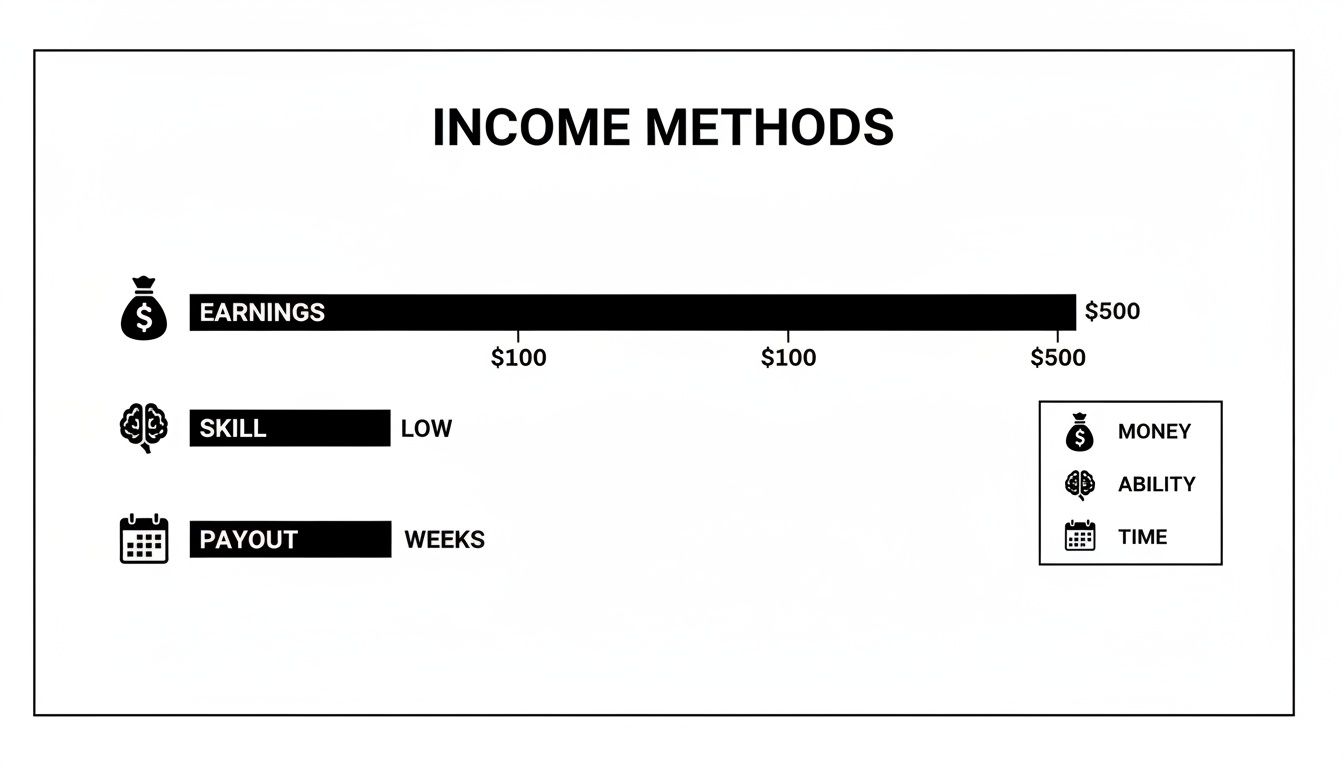
As you can see, the options with a lower skill barrier tend to pay out faster. These are perfect for getting some cash in your pocket. They prove to yourself that this is real.
Ready To Build More Traffic And Income?
Use Internet of Business to learn blogging, SEO, affiliate marketing, passive income, and digital business systems that compound over time.
Start Building Your Digital Income →Beginner-Friendly Online Income Methods at a Glance
To give you a clearer picture, here is a quick comparison of the most popular online income streams for people just starting out.
| Method | Typical Beginner Earnings (Monthly) | Required Skill Level | Time to First Payout |
|---|---|---|---|
| Freelancing (Writing, Design, etc.) | $200 – $1,000+ | Low to Medium | 1-4 Weeks |
| Microtasks (Surveys, Data Entry) | $50 – $200 | Very Low | 1-2 Weeks |
| Affiliate Marketing | $0 – $300 | Low | 1-3 Months |
| Virtual Assistant (VA) | $300 – $1,500 | Low to Medium | 2-4 Weeks |
| Selling on Marketplaces (Etsy, eBay) | $100 – $500 | Low | 1-3 Weeks |
This table helps illustrate the trade-offs. While microtasks pay quickly, the earning potential is limited. Freelancing might take a bit longer to land the first client. However, the income ceiling is much higher.
Key Principles for Beginner Success
From the very beginning, you need to think like a business owner. This is true even if it's just a small side hustle. That means being professional and hitting your deadlines. It also means actively looking for your next opportunity. Every small task is a chance to build a reputation that will pay off down the road.
The most critical step is always the first one. You do not need a perfect, 10-page business plan to start. You just need to take action, learn as you go, and be willing to adjust your course along the way.
If you have some expertise you'd like to share, learning how to start making money with online courses can be an incredibly rewarding path. It also pays to get a broad overview of the entry-level landscape; our guide to online jobs for beginners covers a wide range of opportunities in more detail.
Landing Your First Gig with Freelancing
If you're asking how to make money online for beginners without a long, drawn-out process, freelancing is your answer. It is the most direct path. You sell a service you're already good at to clients who need it. This approach skips the long ramp-up time of passive income models. It lets you see cash flow much sooner.
Think of platforms like Upwork and Fiverr as massive digital marketplaces. They're designed to connect skilled individuals with businesses that need specific tasks done. It is like hanging a shingle outside your door, except your potential client base is the entire world.
The concept is beautifully simple. You build a profile showcasing your abilities. You decide on your pricing. Then you start applying for projects or offering pre-packaged services. It is a straightforward trade—your expertise and time for money.

Building a Profile That Attracts Clients
Your profile is your digital storefront. It's the first thing a potential client sees, so it has to make an impact. A half-finished or generic profile simply will not get noticed. The entire goal here is to build instant trust. You must convince clients you are the solution to their problem.
First things first, get a professional headshot. No blurry selfies from a night out. Next, nail your headline. Instead of a vague "Freelancer," be specific. Something like "Reliable Data Entry Specialist" or "Enthusiastic Social Media Assistant" immediately tells clients what you do.
Your bio or description should tell a compelling story. Do not just list tasks you can do. Focus on the problems you solve for people.
- Pinpoint Your Skills: Name the specific software you have mastered (like Microsoft Excel or Canva). List tangible abilities (like a 70 WPM typing speed).
- Showcase Your Value: Connect your skills to a client benefit. For example, "I help busy entrepreneurs free up their time by managing their social media content calendars."
- Set a Smart Rate: Look at what other beginners in your field are charging. If you price yourself too high, you will scare people off. But go too low, and you risk looking inexperienced.
One of the biggest mistakes I see beginners make is trying to be a jack-of-all-trades. Specializing in one or two key services makes you look like a focused expert. This is exactly what high-quality clients are looking for.
Popular Entry-Level Freelance Services
You do not need a decade of experience or a fancy degree to jump in. Many of the most in-demand freelance roles are perfectly suited for beginners. It is all about leveraging the skills you already have. This is true even if you have never thought of them as "professional" before.
For instance, freelance transcription is one of the most accessible starting points. If you can type accurately and have a computer, you are pretty much set. Platforms like Rev and TranscribeMe let you sign up. You pass a quick skills test and then begin claiming jobs.
According to Upwork's data, freelance writers and those in similar remote gigs like transcription average £15-£75 per hour globally. For entry-level transcription, that translates to around $0.30-$1.10 per audio minute.
Other fantastic starting points include:
- Data Entry: Simply moving information from one format to another.
- Social Media Assistance: Scheduling posts, replying to comments, and creating basic graphics.
- Virtual Assistance: A catch-all for administrative tasks like managing emails and calendars.
For even more ideas, check out our guide on the best freelance websites for beginners to see which platform fits you best.
Writing a Winning Proposal
Once you have found a project that looks like a good fit, it is time to write your proposal. This is your sales pitch, and it needs to be sharp. Clients can spot a generic, copy-pasted message a mile away. You should avoid them at all costs.
Actually read the job description. I mean, really read it. Your proposal should be a direct response to the client’s specific needs. Acknowledge their project. Explain exactly why your skills are the perfect match. Give a brief overview of how you'd tackle the work.
Always end with a clear call to action. For example, "I am available to start immediately and would be happy to discuss this further." As you land more gigs, knowing how to list freelance work on your resume becomes crucial for leveraging that experience into even better opportunities down the line.
Building Sustainable Income with Affiliate Marketing
If you've considered more active ways to make money online, like freelancing, you might be looking for something with more long-term, passive potential. That is where affiliate marketing comes in. It's less about trading hours for dollars. It's more about building a real business that can generate income around the clock.
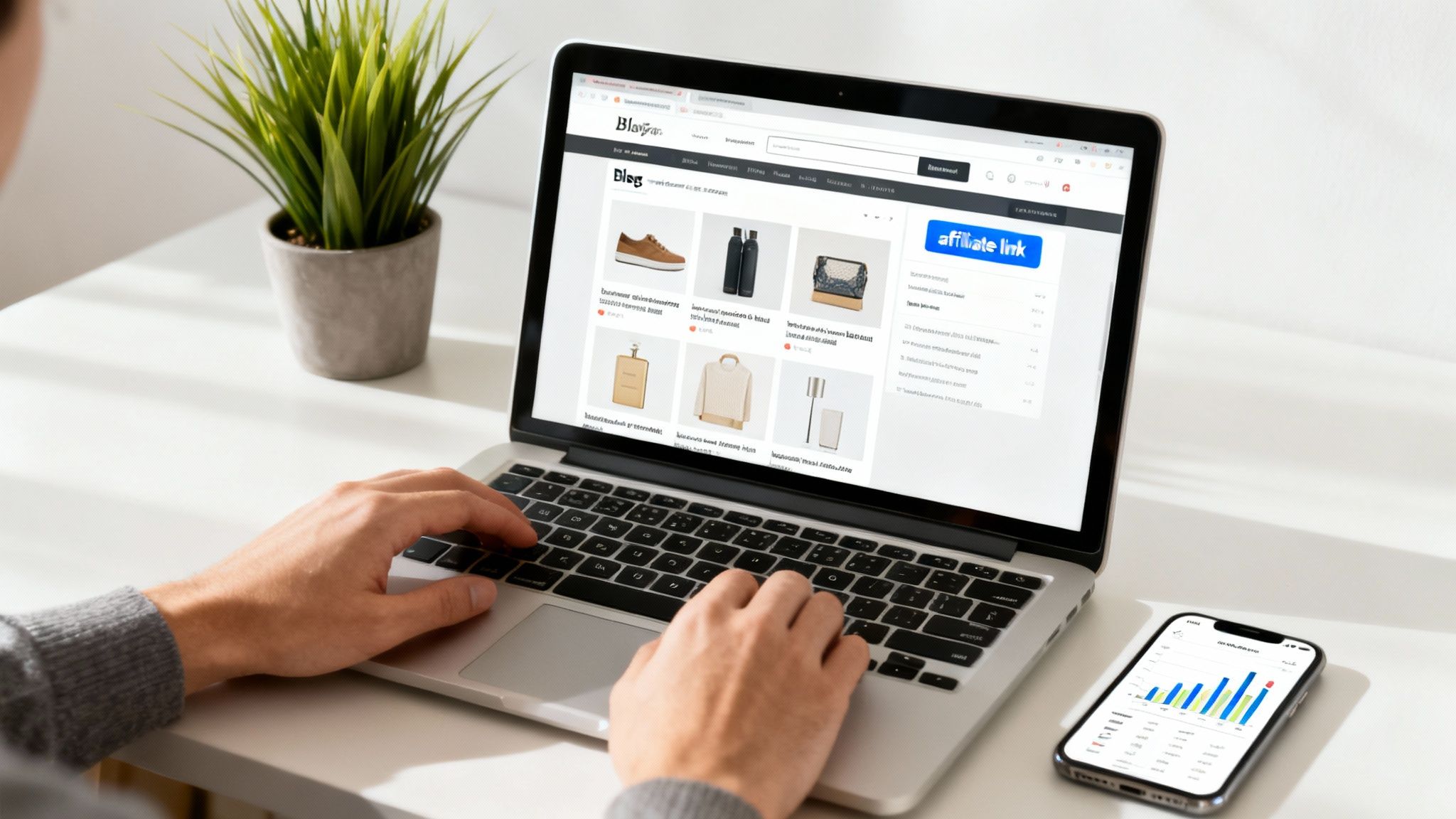
The idea is straightforward. You earn a commission by recommending products or services you genuinely like. You get a special tracking link. When someone uses it to make a purchase, you get a cut. This is not about being a pushy salesperson. It is about sharing valuable insights with an audience that trusts you.
For example, say you are passionate about home coffee brewing and run a blog on the topic. You could write an in-depth review of your favorite espresso machine. You can complete it with photos and brewing tips. Within that article, you would place your affiliate link. When a reader clicks through and buys that machine, you earn a commission. It does not cost them a penny extra.
Finding Your Profitable Niche
Before you can recommend anything, you need to decide what you will talk about. This is your niche. The sweet spot for a great niche is where your personal interests overlap with a market of people willing to spend money.
What are your hobbies? Your areas of expertise? Think about what you could talk about endlessly. Whether it is sustainable fashion, high-end PC gaming, or gluten-free baking, your passion is the fuel. You will be creating a ton of content. It is a lot easier when you actually enjoy the subject matter.
Once you have some ideas, do a little digging. See if there are products you could promote. See if people are actually searching for information on the topic. A solid niche has both an engaged audience and products they want to buy.
Building Your Content Platform
Your content is the heart of your affiliate business. For most beginners, a blog is the best place to start. It is the perfect platform for building trust and attracting visitors from search engines like Google over time.
The name of the game is creating genuinely helpful content that solves problems for your readers. This is not the place for thin articles crammed with links. Your number one job is to provide real value.
Here are a few content formats that work incredibly well:
- Deep-Dive Product Reviews: Go beyond the specs and share your honest, hands-on experience.
- "Best Of" Roundups: Curated lists, like "The 5 Best Laptops for College Students," save readers time.
- How-To Guides: Step-by-step tutorials that show someone how to achieve a result, often using a specific product.
- Comparison Posts: Pit two popular products against each other to help readers choose the right one for them.
This approach builds credibility. People will be far more likely to trust your recommendations and use your links. They will see you are focused on helping them make smart choices. To really get into the weeds on this, you might find value in our detailed guide on how to start affiliate marketing.
Joining Affiliate Programs and Placing Links
With a niche chosen and a content plan in place, it is time to find companies to partner with. Many people new to this start with large affiliate networks. They offer access to thousands of brands and are generally easy to join.
Amazon Associates is a classic first stop. As Amazon’s official affiliate program, it gives you access to millions of products. The commission rates can be on the lower side. But the sheer volume of products and Amazon’s high conversion rate make it a reliable choice.
Other great networks to explore include:
- ShareASale: A huge marketplace with a great mix of big brands and smaller, niche companies.
- CJ Affiliate (formerly Commission Junction): Home to many of the world's largest and most well-known brands.
- ClickBank: A popular choice if you are interested in promoting digital products like online courses and ebooks.
Once you are approved for a program, you can start creating your unique affiliate links. The trick is to weave them into your content naturally. If you mention a specific camera in a photography guide, that is the perfect place to link to it. Just avoid plastering links everywhere—it looks spammy and will drive people away.
Affiliate marketing is a marathon, not a sprint. It is crucial to have the right expectations from the start. While top-tier sites can pull in $20,000+ a month, a more realistic timeline for a beginner is 6-12 months of consistent work to start seeing $500-$5,000 in monthly earnings.
With commissions from programs like Amazon Associates typically falling between 1-10%, promoting a $100 product could net you $5-$10 per sale. It is a numbers game that requires patience. But with total affiliate marketing spending projected to hit $15 billion in 2025, the opportunity is massive. This long-term mindset is what truly separates successful affiliate marketers from those who quit too soon.
More Proven Ways to Make Money Online
If freelancing or affiliate marketing does not feel like the right fit, do not worry. There are plenty of other fantastic ways to start earning online. Each taps into different skills and interests. Whether you're a creative soul or a savvy bargain hunter, you can find a path that genuinely excites you.
Let's dive into a couple of my favorite business models that are perfect for beginners.
One of the most powerful ways to build an online business is by creating and selling your own digital products. This is where your creativity can turn into a real asset that you can sell over and over again. The best part? It is largely passive. Once you've done the initial work of creating the product, it can continue to bring in money for months, or even years, with very little maintenance.
Sell Your Creativity with Digital Products
So, what exactly are digital products? Think of things like printable planners, ebook templates, or custom social media graphics that people can buy and download instantly.
You do not need to be a graphic design pro to get started. Honestly. Tools like Canva have made it incredibly easy for anyone to create professional-looking products without any specialized training.
Once you have made something, you can sell it on a marketplace that already has a built-in audience. Etsy is a goldmine for this. It is a massive platform where millions of shoppers are actively looking for unique digital downloads. It puts your creations right in front of people who are ready to buy.
Here is a simple look at how it works:
- Find a popular need. Spend some time on Etsy and see what people are searching for. Are budget trackers, wedding invitations, or workout planners trending?
- Create your product. Use a tool like Canva to design your template. Your goal is to make something that is both useful and looks great.
- List it and make it shine. Upload your product to your Etsy shop with a killer title, a good description, and eye-catching images to attract customers.
- Give it a boost. While Etsy brings you traffic, you can always share your products on social media sites like Pinterest to drive even more sales.
The real magic here is the scalability. A single, well-designed planner can be sold hundreds or even thousands of times. This can generate passive income while you sleep.
Turn Bargains into Profit with Online Reselling
If you love the thrill of the hunt, online reselling might be your calling. This is all about finding undervalued items at places like thrift stores, garage sales, or clearance racks. You can flip them for a profit on an online marketplace. It is a very hands-on business that can start bringing in cash pretty quickly.
Platforms like eBay and Facebook Marketplace are your best friends here. They connect you to a huge audience of buyers looking for everything from vintage jackets to used electronics. Your profit is simply the difference between what you paid for an item and what you sell it for, after any platform fees.
A good reselling workflow usually looks like this:
- Find your inventory. Start with what you know. If you are a video game nerd, hunt for classic titles that are priced too low.
- Clean and photograph it. Presentation is everything. Clean your items up and take clear, well-lit photos from every angle. This builds trust with buyers.
- Write a great listing. Be honest and detailed in your descriptions. Include measurements, point out any flaws, and use keywords people would search for.
- Ship it fast. As soon as something sells, pack it securely and get it in the mail. Fast shipping is a huge driver of positive feedback.
This approach is so direct and satisfying. You control your inventory and your pricing. There is nothing quite like the feeling of seeing an item you found for $2 sell for $25.
Both digital products and reselling are fantastic entry points for anyone new to making money online. They do not require a big upfront investment. You will learn incredibly valuable skills in marketing, sales, and e-commerce along the way. Your choice really comes down to what you prefer. Do you want a creative, mostly hands-off business, or one that is more active and hands-on?
Turning Your Plan Into Profit and Dodging the Pitfalls
All the knowledge in the world will not put a single dollar in your bank account. You have to act on it. This is the exact spot where so many aspiring online earners get stuck. They fall into the "research rabbit hole" and never actually start.
The key is to stop thinking about the massive end goal, like "build an online business." Instead, focus on what you can do right now. Breaking it down into small, concrete tasks is how you build real momentum.

A Blueprint for Your First 7 Days
To get you off the starting block, I have put together a simple, one-week action plan. This is not about getting rich overnight. It is about building a solid foundation. It is about proving to yourself that this is doable.
| Day | Primary Goal | Action Items |
|---|---|---|
| Day 1 | Self-Assessment | List 3 marketable skills (e.g., fast typing, proofreading, social media savvy). |
| Day 2 | Platform Research | Pick 1 platform that fits your skills (e.g., Upwork for VAs, Fiverr for writers) and explore it. |
| Day 3 | Profile Creation | Sign up and create a basic profile. Do not overthink it—just get it done. |
| Day 4 | Market Analysis | Find 5 successful people on the platform and analyze their profiles. What do they do well? |
| Day 5 | Craft Your First Offer | Looking for how to write a business plan step by step? Write a draft of your first gig or service offering based on your market analysis. |
| Day 6 | Send Your First Pitch | Find one relevant project or gig and apply. The goal is action, not perfection. |
| Day 7 | Refine and Repeat | Review your profile and offer. Tweak it based on what you have learned and send a second pitch. |
Following this checklist is how you overcome that initial inertia. Once you start moving, it is so much easier to keep going.
Side-Stepping the Traps That Snare Most Beginners
On your journey to figuring out how to make money online for beginners, you are going to run into some predictable roadblocks. Knowing what they are ahead of time makes them much easier to navigate.
The biggest one is analysis paralysis. This is the feeling of being so swamped with options that you do nothing at all. The fix? Commit to just one method for the next 30 days. That is it. Give it a real shot before you even think about switching gears.
Another major pitfall is the siren song of get-rich-quick schemes. Let us be real: legitimate online income takes effort. If someone promises you a fortune for zero work, it is a scam. Full stop. Real online businesses are built, not stumbled upon.
The most successful online entrepreneurs do not have a secret formula. They have a bias for action and the resilience to learn from their mistakes. Your first attempt is a learning experience, not a final verdict on your potential.
Setting Expectations That Won’t Burn You Out
Your mindset is everything. You have to set goals that keep you motivated, not ones that set you up for failure. Dreaming of making $10,000 in your first month will almost certainly lead to disappointment.
A much smarter, healthier approach? Aim for your first $100.
Once you hit that milestone, your next target is $250, then $500. These small victories are powerful. They build incredible confidence and prove that what you're doing is actually working. This keeps you in the game for the long haul.
For active income like freelancing, a realistic timeline is landing your first paying client within two to four weeks. For more passive methods like blogging or affiliate marketing, you should not expect any real income for at least six to twelve months. Patience is not just a virtue here; it is a core business strategy.
If you want to be sure your business ideas have legs before you invest too much time, take a look at our guide on how to validate a business idea. It can save you a ton of headaches down the road.
Common Questions from Newcomers to Earning Online
Diving into the world of online income brings up a ton of questions. That is perfectly normal. Feeling a bit of excitement mixed with a healthy dose of "can I really do this?" is part of the process. Let us clear the air and tackle some of the most common things people wonder about when they're just starting out.
Think of this as a conversation with someone who has been there. These are the straight answers I wish I had had when I first started.
How Much Can I Realistically Make in the Beginning?
This is the big one, right? Your initial earnings really come down to which path you take and how much time you put in. Setting realistic expectations from the get-go is the key to not getting discouraged.
If you are diving into active income like freelancing, a dedicated beginner can reasonably aim to pull in $200-$500 in their first month. That usually means carving out about 10-15 hours of focused work each week to land those first few clients and deliver great results.
Now, for something more passive like affiliate marketing, you have to play the long game. Honestly, you should expect to make next to nothing for the first six months—maybe $0 to $50. It is a slow burn.
But that patience can really pay off. After a solid year of creating content and figuring out what works, a well-run niche blog can easily start bringing in a steady $500 to $2,000+ per month.
What Does it Actually Cost to Get Started?
Here is the best part about making money online: the barrier to entry is incredibly low. Many of the best, most proven methods cost absolutely nothing to kick off.
You can jump on freelance platforms like Upwork or micro-task sites and create a profile to start offering your services today. You can do this without spending a dime. These sites are built to help you get your foot in the door and start earning right away.
If you are thinking bigger, like building a blog for affiliate marketing, the startup costs are still minimal. You are basically looking at:
- Domain Name: This will run you about $12 for the year.
- Web Hosting: You can get a solid, basic hosting plan for just $3-$5 per month.
A word of warning: be extremely cautious of any program or "opportunity" that asks for a big investment upfront. Legitimate ways to earn online are about the value you create, not the fees you pay.
How Do I Spot and Avoid Scams?
Navigating the online world requires a bit of street smarts. A healthy dose of skepticism will be your best friend in dodging the scams that are unfortunately out there.
First and foremost, never, ever pay for a job. Legitimate clients and companies will not ask you for money to start working. This is the single biggest red flag.
Second, if it sounds way too good to be true, it is. Looking for work from home jobs no experience? The reality is nobody is going to pay you thousands of dollars a week for entry-level work with no experience. Those are just hooks to pull you into a scam. Real work takes real effort.
Your safest bet, especially at the start, is to stick to reputable platforms. Marketplaces like Fiverr and Upwork have your back with secure payment systems and dispute resolution. And as a final rule of thumb, never give out your personal bank details anywhere other than the platform’s official, secure payment portal.
What Skills Do I Need to Get Started?
You might be surprised to learn that you probably already have the skills you need. You do not have to be a tech wizard or a marketing genius. It is more about recognizing the value of the skills you use every day.
For example, if you are a great communicator and super organized, you have the foundation for in-demand roles. Think about roles like content writing or virtual assistance.
Here are a few skills that are incredibly easy for beginners to monetize:
- Fast, Accurate Typing: This is the bread and butter of transcription services, a perfect entry-level gig.
- An Eye for Detail: Essential for data entry jobs where you are just moving information accurately from one place to another.
- Basic Social Media Savvy: If you know how to navigate Instagram or Facebook, you are already qualified to help small businesses with their social media management.
The fastest way to earn your first dollar online is to take stock of what you're already good at. Find the online service that matches that talent, and you will be on the right track.
Are you looking for better ways and tools to build your monthly revenue and brand? Be sure to check out our other resources located here to speed up the process.
Nathan
Dr. Nathan Pennington, DBA, earned his Doctor of Business Administration degree from the University of Missouri-St. Louis and brings over 15 years of online entrepreneurial experience in helping people learn how to blog, earn income online and build passive income streams outside of what the school system teaches.


