
How to Become a Freelance Writer With No Experience

Disclosure: This post may contain affiliate links, meaning if you decide to make a purchase through my links I may earn a commission at no additional cost to you. See my disclosure for more info.
Build A Smarter Online Business
Want to turn your content into traffic, income, and long-term freedom? Start with the guides built to help you grow smarter.
Explore Online Business Guides →Learning how to become a freelance writer with no experience comes down to three things. You must get the basic skills down. You need to create a portfolio from scratch. And you must learn how to sell yourself. You don’t need a fancy degree to make this work. What you do need is a smart plan and the grit to see it through. This guide is that plan.
Back to Summer Side Hustles to Earn More
Your Guide to Starting a Writing Career Today
If you’re here, you’re likely drawn to a more flexible way to work. The thought of writing for a living is powerful. You can control your own schedule and decide your own income. But for most people, the biggest roadblock isn’t a lack of talent. It’s that paralyzing feeling of not knowing where on earth to begin.
The great news? You’ve picked a fantastic time to jump in. The freelance world isn’t some tiny niche anymore. It’s a huge, booming part of the global economy. As of 2025, the global freelance workforce is estimated to be 1.57 billion people. That’s about 46.6% of the entire global workforce. This massive shift means businesses are starving for independent talent, especially writers.
This isn’t just a trend. It’s a fundamental change in how work gets done. Businesses of every size need a constant stream of content. This creates a direct pipeline for new writers like you to step in and find opportunities.
Shifting from Employee to Entrepreneur
The first and most important thing you have to change is your mindset. When you go freelance, you’re no longer an employee. You’re a business owner. This one shift in thinking changes everything.
An employee waits for work to be assigned. A business owner goes out and finds it.
The freelance journey isn’t about waiting for permission to write. It’s about giving yourself permission to build a business. You can solve problems for clients and get paid for the value you deliver.
This means you are now in charge of everything:
Ready To Build More Traffic And Income?
Use Internet of Business to learn blogging, SEO, affiliate marketing, passive income, and digital business systems that compound over time.
Start Building Your Digital Income →- Finding your own clients: You are now the marketing and sales department.
- Managing your finances: You’ll send invoices, chase payments, and save for taxes.
- Directing your own growth: You get to decide what skills to learn next. You also decide what services you’ll offer.
It’s a proactive role, not a reactive one. If you want to dig deeper into this transition, our guide on how to start freelancing covers this shift in more detail.
Debunking the “Experience” Myth
Let’s tackle the elephant in the room: you don’t have “professional” writing experience. Here’s a little secret, most clients don’t care about your resume. They don’t care about your past job titles. They care about one thing and one thing only: Can you solve their problem?
Their problem might be a blog that gets no traffic. It could be emails that never get opened. It might be website copy that isn’t turning visitors into customers. Your job isn’t to show them a C.V. It’s to prove you have the solution. A degree in journalism is nice, but it’s not required. A long list of past employers is irrelevant. Your portfolio and your pitch are what do the talking.
This whole process can be broken down into a simple, logical flow.
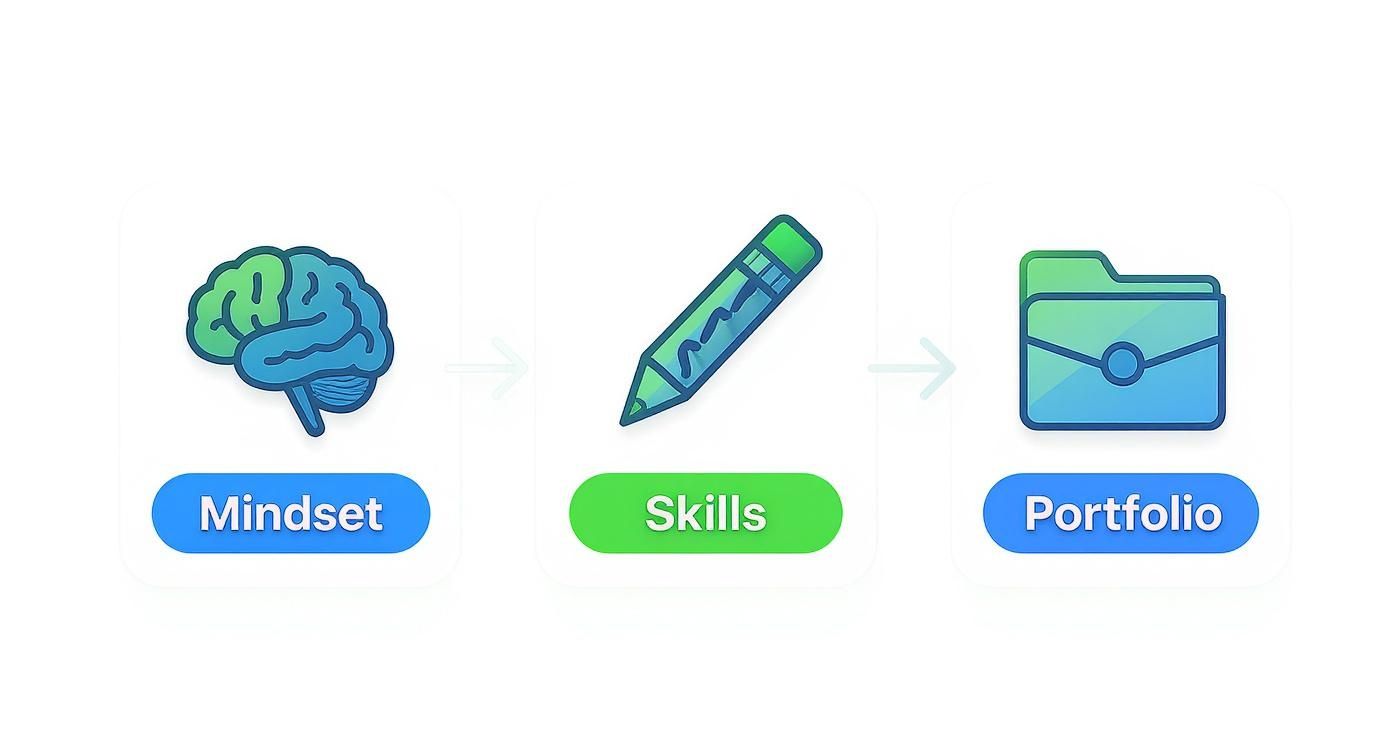
As you can see, it all starts with your mindset. From there, you build skills. Then you turn those skills into tangible proof with a portfolio. These are the three pillars of your new career. This post will walk you through each one with real, actionable steps. It will get you from zero to your first paid project.
To make this even clearer, I’ve put together a quick-start plan. Think of this as your high-level roadmap for the first few weeks.
Your Freelance Writing Quick Start Plan
| Action Step | Why It Matters | Your First Move |
|---|---|---|
| Pick a Niche | You can’t be an expert in everything. A niche helps you focus your skills and makes it easier for the right clients to find you. | Brainstorm 3 topics you know or love. Examples: homebrewing, SaaS marketing, sustainable fashion. |
| Create 3 Portfolio Pieces | This is your proof. Clients need to see that you can actually write, not just say you can. | Write 3 sample articles or blog posts within your chosen niche. They don’t need to be published anywhere. |
| Set Up a Basic Profile | You need a professional online presence. It acts as your digital storefront for potential clients. | Create a simple but professional-looking profile on LinkedIn. Optimize your headline and “About” section. |
| Send Your First 5 Pitches | Action creates momentum. You can’t get clients without asking for work. | Find 5 businesses in your niche and send them a personalized email pitching a specific article idea. |
This table isn’t just a to-do list. It’s the foundation for everything that follows. Each step is designed to build on the last. It creates the momentum you need to land that first client.
Developing the Writing Skills Clients Actually Pay For

Just writing a lot isn’t enough to build a freelance career. This is especially true when you’re starting from square one. If you want to know how to become a freelance writer with no experience, the secret is to stop thinking like a generalist. You need to start focusing on the specific, marketable skills businesses are desperate for.
Good writing is a great start. But professional writing is a craft that solves a business problem. That’s what clients pay for. Platforms like Fiverr, Freelancer or Clickworker are all great platforms to get started on too.
The first step is to get your head around the three main buckets of online writing. They each do a different job. Once you understand the difference, you can position yourself as someone who delivers real value.
Content Writing vs Copywriting vs SEO Writing
It’s tempting to think all online writing is the same. But clients don’t see it that way. They hire writers to achieve very specific goals. Understanding those goals is your ticket to getting paid well.
Content Writing: This is all about building trust and authority. You do this by educating, informing, or entertaining. Think blog posts, articles, and guides. The main goal here is engagement. You want to get people to read, share, and see the brand as a go-to expert.
Copywriting: This is pure persuasion. Copywriting has one job: to get the reader to take a specific action. This could be buying a product or signing up for a newsletter. You’ll find it on sales pages, in email campaigns, and in ads. Success is measured by one thing: conversions.
SEO Writing: This is a special type of content writing. It’s designed to get a page to the top of Google. It’s a technical craft that involves using keywords strategically. You also structure articles for search engines. And you must make sure the content directly answers what a user is searching for. I would strongly consider platforms like KWFinder to help you with this. It’s the engine that drives free, organic traffic.
The biggest mistake I see new writers make is blurring these lines. A blog post has a different purpose than a sales page. And both benefit from search optimization. Mastering these distinctions makes you instantly more valuable to a client.
Knowing this framework helps you pick a lane. For most people breaking into the field, content writing and some basic SEO writing are the most accessible skills to learn first.
Mastering Clarity and Brand Voice
Beyond knowing what you’re writing, two core skills will put you miles ahead of the competition: clarity and adaptability. Clients aren’t just buying words. They’re hiring you to deliver their message perfectly to their audience.
Clarity is King
Your writing absolutely must be easy to understand. That means using simple words and shorter sentences. You need a logical flow that guides the reader. People scan online. They don’t read every word. Your ability to get a point across quickly is non-negotiable.
A great way to train this muscle is with a free tool like the Hemingway App. Just paste your text in. It will flag complex sentences, passive voice, and weak words. It forces you to write with punch and directness. For a deeper dive, these blog writing tips for beginners are packed with actionable advice on creating readable posts.
Adapting Your Tone of Voice
Every brand has its own personality. A funky startup sounds different from a serious B2B cybersecurity firm. As a freelance writer, your job is to be a chameleon. You need to slip into your client’s brand voice and make it your own.
Here’s a practical exercise to build this skill:
- Pick three different brands you like. Try a tech company, a fashion label, and a health food brand for variety.
- Read their “About Us” page and a few blog posts. Pay close attention to their word choice, sentence length, and the overall vibe.
- Try to describe their voice. Is it witty? Authoritative? Inspirational? Professional?
- Write a short paragraph mimicking each style.
This simple exercise trains your ear to hear the nuances in brand voice. It proves to potential clients that you can write for them, not just for yourself. It’s a skill that builds incredible trust. It is the foundation for a long and successful career.
How to Build a Portfolio When You Have No Clients

This is the classic chicken-or-egg problem every new freelancer faces. You need a portfolio to get writing jobs. But you need jobs to build a portfolio. It feels like a catch-22, but I promise you, there’s a way out. In fact, you can solve this entirely on your own without a single paying client.
Think of your portfolio as your #1 sales tool. It’s the hard proof that you can actually do the work you’re pitching for. A fantastic portfolio makes clients forget you’re just starting out. It shows them you can write. It shows you get their industry and can solve their problems.
The secret? You have to create your own work. By proactively making your own writing samples, you’re not just showing off your writing chops. You’re proving you have initiative, a trait every client is looking for.
Create “Spec” Pieces That Wow Potential Clients
The single fastest way to fill a portfolio is by creating speculative pieces, or “spec pieces.” These are articles you write as if a specific brand had already hired you. No, you don’t get paid for them. But their value in landing actual work is enormous.
Don’t just write a generic article on a broad topic. Instead, choose a real brand you’d love to work with in your niche. Dive deep into their blog. Get a feel for their tone of voice. Find a content gap they haven’t addressed. Then, write an article that fits so perfectly, it looks like it belongs on their site.
This approach is brilliant for two reasons:
- It proves you’ve done your research and understand what that brand needs.
- It gives you a super-relevant writing sample you can show to other, similar clients.
For example, if you want to write for B2B SaaS companies, skip the boring “benefits of CRM” post. Get specific. Write something like, “Salesforce vs. HubSpot: Which CRM Is the Right Choice for Your Small Business in 2025?” That’s a piece with real-world value.
Start Your Own Blog (It’s Your Digital HQ)
Another incredibly effective strategy is to start your own blog in your chosen niche. This becomes a living, breathing portfolio that you own and control completely. Every post you publish is another piece showcasing your skills and knowledge.
A personal blog shows consistency and a genuine passion for your subject. More than that, it provides a professional home base you can link to. You can use it in your pitches and social media profiles.
Your blog isn’t just a collection of articles. It’s your business headquarters. It’s where you prove your expertise and attract clients through SEO. It’s where you build a brand that is uniquely yours. It shifts your identity from a writer-for-hire to an authority in your field.
Getting a blog up and running doesn’t have to be a massive undertaking. You can focus on a tight niche. This could be a lifestyle blog about sustainable living or a finance blog about achieving financial independence. If that sounds interesting, you can learn more about how to start a lifestyle blog to see what’s involved.
Use Guest Posting to “Borrow” Credibility
Guest posting is when you write an article for another website’s blog. This is usually for free. You’re not getting a paycheck. But you’re getting something that can be even more valuable early on: a published byline on an established site.
This is a complete game-changer for new writers. A published guest post is instant social proof. It tells potential clients, “Hey, this editor trusted me enough to publish my work on their platform.” That kind of endorsement can elevate your credibility overnight.
Finding these opportunities is pretty straightforward. Just head to Google and try searches like:
[Your Niche] + "write for us"[Your Niche] + "guest post guidelines"[Your Niche] + "become a contributor"
Once your post goes live, you have a powerful portfolio piece. It will be complete with a link to a real publication and an author bio. It’s a clear signal to clients that you’re a pro who can follow editorial guidelines.
Where to House Your Portfolio
Okay, so you’ve created three to five killer writing samples. Now what? You need a professional place to show them off. Just sending a client a folder of Google Doc links looks amateur. A dedicated online portfolio is non-negotiable.
You’ve got plenty of great, easy-to-use options. You’ll want a clean, professional online portfolio. This helps showcase your work in a way that attracts clients. You can check out some of the best website builders for freelancers to see what might work for you. Many of them have simple drag-and-drop tools that are perfect for beginners.
Whether you opt for a simple website builder or a dedicated platform, the goal is the same. Make it ridiculously easy for a potential client to see your best work in a single glance.
Finding and Landing Your First Paying Client

Okay, you’ve got a solid portfolio in your back pocket. The prep work is done. Now it’s time to get out there and actually make some money. This is where we take those shiny new skills and samples. We put them in front of businesses ready to pay for them.
The great news? You’re stepping into a booming market. Freelancing isn’t a last resort anymore. It’s a deliberate career move. In fact, around 70% of gig workers are in it by choice, not because they have to be.
Plus, about 32% of freelancers jump in right after—or even during—their education. This proves you don’t need a long corporate resume to make it work. It’s a field built for hungry self-starters just like you. For more on this, check out the latest freelancing trends on clientmanager.io.
Where to Find Your First Writing Gigs
Knowing where to look is half the battle. If you waste time on the wrong platforms, you’ll just get discouraged. The trick is to focus your energy where you’ll get the best results as a beginner.
You’re looking for clients who care about quality. You need clients willing to give a new writer a fair shot.
Your search can be broken down into a few key places:
- Freelance Marketplaces: Sites like Upwork and Freelancer are the usual first stop. They connect clients and freelancers for specific projects. Yes, they’re competitive. But they also offer a clear path to finding jobs and getting paid without any fuss.
- Quality Job Boards: Forget the low-paying “content mills.” I’m talking about curated job boards that list real opportunities. Websites like ProBlogger and Freelance Writing Jobs post legitimate gigs from companies that are actively looking for skilled writers.
- Direct Outreach: This is my personal favorite. It’s all about finding companies you genuinely like in your niche. Then you reach out to them directly. This means cold emailing and connecting on LinkedIn. It often leads to better-paying, long-term work because you’re creating the opportunity yourself.
A lot of new writers get stuck trying to find the one “perfect” platform. The best approach is to mix it up. Spend some time applying on marketplaces to get some quick wins. Do this while you research companies for direct outreach.
For a deeper dive into all your options, our guide on the 18 places to find freelance writing jobs is a fantastic resource to get you started.
Crafting a Pitch That Gets a “Yes”
Think of your pitch as your sales letter and cover letter all rolled into one. If you just copy and paste a generic template, it’s going straight to the trash. A killer pitch, on the other hand, makes the client feel like you’re the only person who gets what they need.
The secret ingredient is personalization. Show them you’ve done your homework.
Instead of saying, “I’m a great writer and I can write blog posts for you,” get specific. Try something like this: “I noticed your blog covers email marketing funnels. But you haven’t touched on how they apply to e-commerce. I’d love to write a 1,500-word post on ‘3 E-commerce Funnel Strategies to Boost Holiday Sales.'”
See the difference? You’re immediately showing initiative and providing real value.
Framing Your Inexperience as a Strength
Whatever you do, don’t apologize for being new. Your fresh perspective is something a jaded veteran might have lost years ago. Your hunger to prove yourself is a huge asset.
You just need to frame it correctly.
| What They Might See | How You Frame It |
|---|---|
| No formal experience | “I bring a fresh perspective and I’m eager to deliver exceptional results to build my reputation.” |
| Small portfolio | “My portfolio features pieces specifically tailored to your industry, showing my dedicated interest and skill.” |
| Lower rates | “As I establish myself, my rates are competitive, offering you top-tier commitment at excellent value.” |
Your enthusiasm and willingness to go the extra mile are huge assets. Use them. Your goal is to make hiring you feel like a smart, low-risk, high-reward decision.
Avoiding Red Flags and Low-Paying Gigs
As you start looking, you have to learn how to spot bad clients. You must also spot exploitative “content mills.” These gigs pay pennies and demand the world. They will burn you out before you’ve even really started.
Keep an eye out for these red flags:
- Insultingly low pay: Any job offering less than 3-5 cents per word is likely a waste of your time.
- Vague job descriptions: Good clients know what they want. A vague request for “some articles” is a sign of disorganization.
- Requests for free “test” articles: A paid trial is perfectly fine. Asking for a full, unpaid article is not.
- Poor communication: If a client is flaky or unprofessional from the start, they’ll be a nightmare to work with.
Learning to say “no” to bad gigs is just as important as finding good ones. You need a steady pipeline of quality clients to build a sustainable business. This often comes from smart marketing. Learning some content marketing best practices will help you attract the kind of clients you actually want to work with.
How to Price Your Work and Manage Your Money
Let’s talk about the part that makes most new writers sweat: money. I get it. Talking about rates can feel awkward. But as a freelancer, it’s a conversation you have to get comfortable with, fast.
Setting your rates with confidence is a huge milestone. It is key to learning how to become a freelance writer with no experience. It is also how you start acting like a real business owner. Trust me, underpricing your work is the quickest way to burn out before you even get started.
The sweet spot is finding a rate that feels fair to you. It also must deliver incredible value to your client. That balance is the foundation of a business that lasts.
Per-Word vs Hourly vs Project-Based Rates
There’s no single “right” way to charge for your writing. Each pricing model has its pros and cons, especially when you’re just starting out. Understanding them lets you pick the best approach for any given project.
Per-Word Pricing: This is the go-to for most online content like blog posts. For a brand new writer, a solid starting point is between $0.05 and $0.10 per word. It’s super straightforward, which clients love. The catch? It doesn’t account for time spent on deep research, outlining, or interviews.
Hourly Pricing: Charging by the hour works well for projects with a fuzzy scope. Think editing gigs or big website rewrites. Beginners can comfortably start in the $25-$40 per hour range. The challenge here is that you need to be good at estimating your time. Some clients get nervous about a running clock.
Project-Based Pricing: This is my personal favorite. You quote a flat fee for the entire project. For example, you might charge “$500 for one 1,500-word blog post.” This is fantastic for setting clear expectations on both sides. Best of all, it rewards efficiency. As you get faster, your effective hourly rate skyrockets.
My advice for your first few projects? Stick with per-word or project-based pricing. It takes the pressure of time-tracking off your shoulders. It keeps the client focused on the final product, not the hours it took you to create it.
Your Strategy for Raising Your Rates
The rates you set today are not your forever rates. As you collect more experience and glowing testimonials, you absolutely must charge more. Your killer portfolio pieces also justify higher rates.
Make it a habit to reassess your pricing after every three to five successful projects.
A simple, no-fuss way to do this is to bump up your base rate by 15-20%. If you started at $0.08 per word, your next logical step is to aim for $0.10 per word. These small, steady increases are easy to justify. Your growing track record supports them. They also feel much less intimidating than a massive price hike.
Don’t get discouraged by the initial numbers. A 2025 author survey showed that while 44% of authors earn $100 or less per month, the other 56% earn more. This is a totally normal place to start. It proves there’s a clear path to growing your income as you build your business. You can check out more insights into self-publishing for authors to see the full picture.
The Business Basics You Can’t Skip
You don’t need a business degree. But you do need to act like a professional from day one. This builds client trust and, more importantly, protects you. A few simple things are all it takes.
A Simple Invoice: You don’t need fancy software. Use a free template from a tool like Canva or even Google Docs. Just make sure it includes your contact info and the client’s info. Add a clear description of the work, the rate, and the total amount due. Clean and simple is all you need.
A Basic Contract: A simple agreement prevents so many future headaches. It should outline the scope of work, the price, and the deadline. Include your payment terms, such as “Payment due within 14 days of invoice receipt.” This isn’t about complex legal jargon. It’s about making sure everyone is on the same page.
Income Tracking: Open up a spreadsheet. Seriously, that’s it. Create columns for the client’s name, project date, and amount invoiced. Also add the date you got paid. This little habit will make managing your finances—and dealing with taxes later on—so much easier.
Got Questions? Let’s Get Them Answered
Diving into freelance writing can feel a little overwhelming at first. It’s totally normal to have a bunch of questions. This is common when you’re figuring out how to become a freelance writer with no experience. Let’s clear up some of the most common ones I hear from new writers.
Think of this as a quick chat to settle any last-minute nerves. We’ve covered the roadmap. Now let’s make sure you feel confident enough to hit the gas.
Do I Really Need a Degree to Be a Freelance Writer?
Nope. Not at all. This is probably the biggest misconception out there. It stops way too many talented people before they even start.
Sure, a degree in English or journalism doesn’t hurt. But it’s not the golden ticket to a freelance writing career. Your clients are business owners, not professors. They care about one thing: results. A killer portfolio will always beat a fancy diploma. It proves you can write clear, persuasive content. Your time is better spent building practical skills and creating samples that show you can solve a client’s problem.
How Long Until I Land My First Client?
Honestly, this one is up to you. The timeline directly reflects how much consistent effort you put in. I’ve seen some writers go all-in and land their first gig in a couple of weeks. For others, it might take a month or two of focused work.
The secret ingredient is momentum. If you’re consistently working on your portfolio and sending thoughtful pitches every single week, landing your first client within 30 to 90 days is a very realistic goal. Just keep moving.
What Are the Most Profitable Writing Niches?
You can definitely start out as a generalist. But picking a niche is the fastest way to increase your rates. When you specialize, you’re not just a writer anymore, you’re an expert. And experts get paid more.
Some of the hottest and most profitable niches right now are:
- Digital Marketing: Think B2B strategy, SEO, and email marketing. Businesses are always hungry for this stuff.
- Finance: Personal finance and especially FinTech are booming. They need writers who can make complex money topics easy to understand.
- Technology: SaaS (Software as a Service) and AI are big-money industries. If you can break down complicated tech, companies will pay a premium for it.
- Health and Wellness: This is an evergreen field. People will always be searching for content on nutrition, fitness, and mental health.
A word of advice, though: don’t just chase the highest-paying niche. Pick something you’re genuinely curious about. Your passion will come through in your writing. It will make the whole process a lot more fun.
Should I Use Upwork or Find Clients on My Own?
Why not both? For a beginner, a hybrid approach is your best bet. Each method has its own perks when you’re just getting started.
Platforms like Upwork are fantastic for getting your feet wet. They provide a constant stream of job postings. They also have secure payment systems, which is a huge relief when you’re new. It’s a great way to get some experience and collect those first crucial testimonials. The downside? The competition is fierce, and they take a cut of your earnings.
Going after clients directly, through cold emailing or connecting on LinkedIn, lets you build direct relationships. It also lets you keep 100% of what you earn. This path often leads to better-paying, long-term work. I always recommend using platforms to build some initial momentum. Simultaneously, you can start your direct outreach. It’s a powerful one-two punch that gives you stability and growth.
At Internet of Business, our goal is to give you a clear, actionable roadmap to build the flexible, profitable career you deserve. Our guides are built to turn your ambition into real results. To keep learning and find more strategies for financial independence, explore our resources page for more helpful tools.
Back to Summer Side Hustles to Earn More
Are you looking for better ways and tools to build your monthly revenue and brand? Be sure to check out our other resources located here to speed up the process.
Nathan
Dr. Nathan Pennington, DBA, earned his Doctor of Business Administration degree from the University of Missouri-St. Louis and brings over 15 years of online entrepreneurial experience in helping people learn how to blog, earn income online and build passive income streams outside of what the school system teaches.


